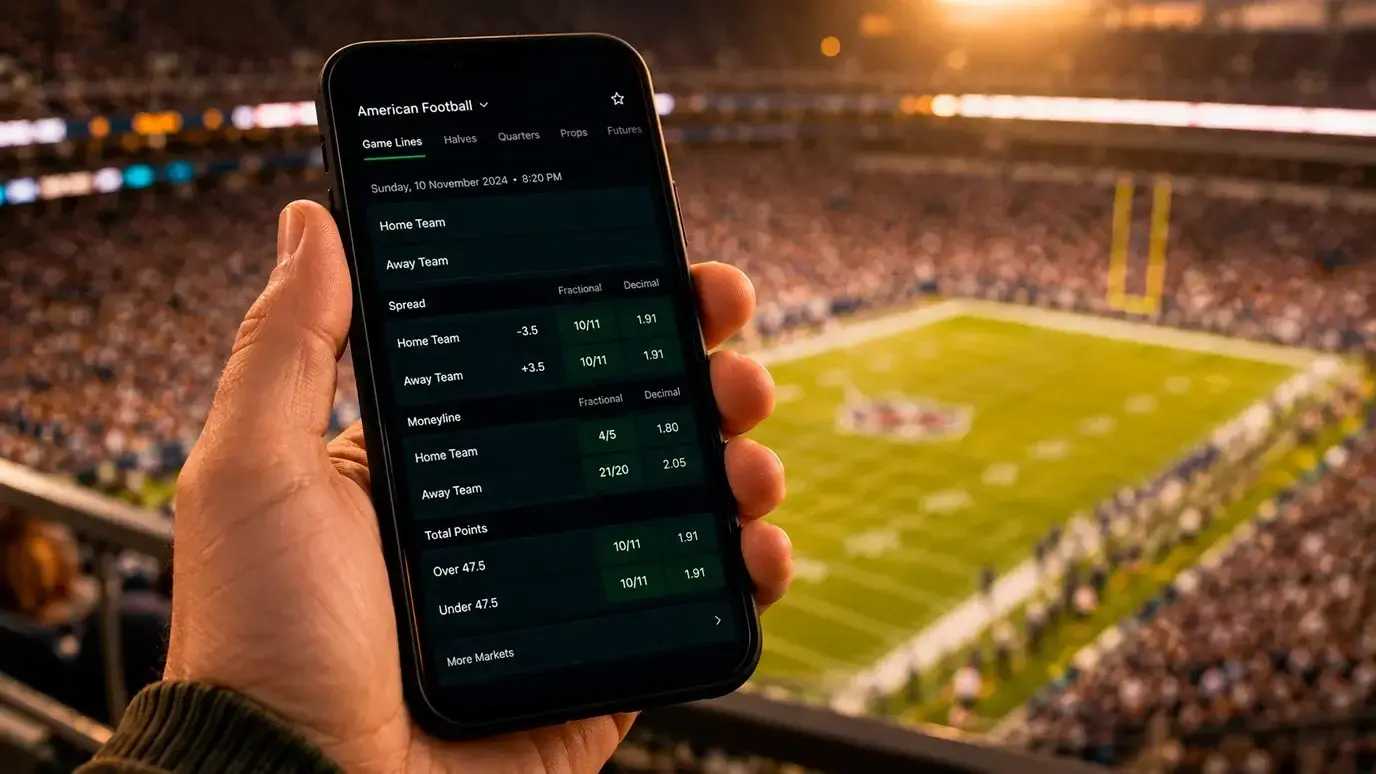
I remember the first time a client asked me to explain why his NFL bet paid out less than he expected. He had backed the Kansas City Chiefs at 4/6, assumed he would win four pounds for every six staked, and could not understand why his return was lower than the guy next to him who had the same pick at 1.67 on a decimal site. Same game, same outcome, same implied edge — but a different number on the screen made him feel cheated. That conversation lasted forty minutes. This guide will save you forty minutes.
Odds are not decoration. They are the single piece of information that tells you exactly what the market thinks about a game and exactly what you stand to collect if you are right. Yet roughly 10% of UK adults bet on sport regularly, and a surprising number of them treat odds as background noise — something the bookmaker sets and they either accept or ignore. In twelve years of analysing NFL wagering markets, I have watched otherwise sharp bettors leave value on the table simply because they never learned to read all three formats fluently.
This article strips the topic back to first principles. I will walk through fractional, decimal and American odds one format at a time, show you how to convert between them without a calculator, and explain the hidden tax that every bookmaker bakes into the price. By the end, you will look at an NFL odds board the way a trader looks at a stock ticker — not as a mystery, but as a signal.
Once you understand how to convert fractional formats into implied probability, you can start maximizing value by claiming the latest NFL free bet offers available this season.
Understanding Fractional Odds: The UK Standard
A few years ago I ran an informal poll in a London NFL watch party. I asked thirty-odd fans to explain what 5/2 means. About half got it right. The other half gave answers that ranged from “fifty-fifty” to “you win five quid.” Fractional odds are the default display on every UKGC-licensed platform, and yet they trip people up more often than any other format.
The structure is simple once you see it. The number on the left is your potential profit. The number on the right is your stake. At 5/2, you profit five units for every two units risked. Stake ten pounds, profit twenty-five, collect thirty-five total. The “/” is not a division sign in the arithmetic sense — it is a ratio. Think of it as “profit-to-stake.”
Where it gets interesting is the shorthand. Odds-on prices appear as fractions smaller than one: 4/6, 2/5, 1/3. These are favourites. You are risking more than you stand to gain, which makes perfect sense when the market believes one team is substantially more likely to win. A Chiefs moneyline at 4/6 means you stake six to profit four. That implies the market gives Kansas City roughly a 60% chance of winning — a number I will unpack properly in the implied probability section below.
Evens — written as 1/1 or simply EVS — is the fulcrum. Stake ten, profit ten, collect twenty. Any price above evens is an underdog; any price below evens is a favourite. This binary split is the fastest orientation tool you have when scanning a full slate of NFL games on a Sunday morning.
One quirk that catches newcomers: fractional odds express profit, not total return. If you see 7/4, your calculator should read “profit equals stake times seven divided by four.” Stake twenty pounds, profit thirty-five, total return fifty-five. The stake comes back on top. I labour this point because the next format — decimal — includes the stake in the headline number, and confusing the two is the single most common error I see.
There is also the question of non-standard fractions. You will occasionally see prices like 11/8 or 13/8 on NFL spreads. These exist because the bookmaker is pricing to a precise margin and the fraction is the closest clean expression of that margin. Do not let odd-looking fractions intimidate you. The maths is identical: profit equals stake multiplied by the top number, divided by the bottom number.
Decimal Odds: The European Alternative
I switched my personal betting accounts to decimal display about eight years ago, and I have never switched back. Not because fractional odds are bad — they are fine for quick mental arithmetic on round numbers — but because decimal odds make one thing effortless: comparing prices across bookmakers.
Decimal odds represent your total return per unit staked, including the stake itself. A price of 3.50 means that for every pound wagered, you collect three pounds and fifty pence if the bet wins. Your profit is 2.50; your original pound comes along for the ride. The formula is dead simple: total return equals stake multiplied by the decimal price.
The beauty of this format is that bigger always means better. At a glance, 3.50 is obviously a higher payout than 3.20. In fractional terms, you would be comparing 5/2 with 11/5 — not impossible, but slower. When you are line-shopping across three or four platforms for a Thursday Night Football spread, speed matters. Decimal odds give you that speed.
Decimal is also the native format across continental Europe and the default on most betting exchanges. If you ever place a lay bet on an exchange, you will be working in decimals whether you choose to or not. Understanding this format is not optional — it is infrastructure.
A practical example. Suppose you fancy the underdog in a Week 6 matchup. One platform offers 4.00, another offers 3.80. On a twenty-pound stake, the first returns eighty pounds (sixty profit), the second returns seventy-six (fifty-six profit). That four-pound difference compounds over a season. Across a hundred bets at the same unit size, choosing the higher decimal price every time could mean hundreds of pounds in additional returns — without picking a single extra winner. This is the core of line shopping across different spreads, and decimal odds make it visible.
One last note: decimal odds below 2.00 indicate a favourite. Exactly 2.00 is the decimal equivalent of evens. Above 2.00, you are looking at an underdog. The threshold is clean and easy to remember.
American Odds: Reading the Moneyline Format
Every September, a fresh wave of UK punters discovers American odds for the first time — usually because they have wandered onto a US-facing stats site or podcast that quotes lines as “-150” and “+130.” The initial reaction is almost always confusion, followed by mild irritation. Why would anyone design a system with plus signs and minus signs? The answer is rooted in a hundred-dollar baseline, and once you see the logic, it clicks.
American odds revolve around the number 100. A minus figure tells you how much you need to stake to profit 100 units. A plus figure tells you how much you profit on a 100-unit stake. So -150 means “risk 150 to win 100,” and +130 means “risk 100 to win 130.” The minus sign marks the favourite; the plus sign marks the underdog. That much is consistent with the other formats.
Where it gets practical for UK bettors: you will encounter American odds on NFL injury reports, analytics sites, and in conversations with anyone who follows the sport from a US perspective. Being literate in the format means you can absorb information faster without pausing to convert. If a respected NFL analyst tweets that a line has moved from -3 (-110) to -3 (-120), you need to know instantly that the book is now charging more juice on the favourite’s side of the spread — a signal that sharp money has pushed the price.
The mental shortcut I use: for minus odds, divide the number by 100 and you get the stake-to-profit ratio. -150 means 1.5 units risked per 1 unit of profit. For plus odds, divide by 100 and you get the profit-to-stake ratio. +130 means 1.3 units of profit per 1 unit staked. Once you internalise that shortcut, the plus/minus system feels no more alien than fractional.
One subtlety worth noting: American odds are the native language of the NFL betting market. Point spreads in the US are almost always quoted at -110 on both sides as a baseline, meaning you risk 110 to win 100. That -110 price is the bookmaker’s standard margin on spread bets. When you see a UK bookmaker offer an NFL spread at 10/11 or 1.91 in decimal, they are expressing the same thing — just in a different dialect.
Converting Between All Three Formats
I keep a small conversion cheat sheet taped to the inside of my notebook. Not because I cannot do the maths — after twelve years it is second nature — but because having it visible saves three seconds per calculation, and those seconds add up during a live Sunday slate when sixteen games kick off in two windows.
Here are the three conversions you need. No more, no less.
Fractional to decimal. Divide the top number by the bottom number, then add 1. Example: 5/2 becomes (5 / 2) + 1 = 3.50. The “+1” accounts for your stake being included in the decimal figure. Another: 4/6 becomes (4 / 6) + 1 = 1.67. Clean and fast.
Decimal to fractional. Subtract 1, then express the result as a fraction reduced to its simplest form. Example: 3.50 becomes 3.50 – 1 = 2.50, which is 5/2. Another: 1.91 becomes 0.91, which is roughly 10/11. You will sometimes get messy decimals — 2.375 becomes 1.375, or 11/8. Do not be afraid of unusual fractions; they are more precise, not more complicated.
Decimal to American. This one splits into two paths. If the decimal is 2.00 or above (underdog), multiply the decimal minus 1 by 100 and put a plus sign in front. Example: 3.50 becomes (3.50 – 1) x 100 = +250. If the decimal is below 2.00 (favourite), divide -100 by the decimal minus 1. Example: 1.67 becomes -100 / (1.67 – 1) = -149, which rounds to -150.
Going from American back to decimal is the reverse. For plus odds, divide by 100 and add 1: +250 becomes (250 / 100) + 1 = 3.50. For minus odds, divide -100 by the American number and add 1: -150 becomes (-100 / -150) + 1 = 1.67.
If this feels like a lot of arithmetic, it is — the first few times. After a dozen conversions, the common NFL prices become muscle memory. You will know without thinking that -110 is 1.91 is 10/11, that +200 is 3.00 is 2/1, that -200 is 1.50 is 1/2. Those three benchmarks cover a huge slice of the NFL odds spectrum, and everything else slots in around them.
A word on rounding: bookmakers round to the nearest clean fraction. That means 1.91 and 1.909090… both display as 10/11. Do not obsess over the third decimal place. The rounding happens at the margin level and the difference on a twenty-pound bet is pennies. Where precision matters is in the implied probability calculation — which is next.
Implied Probability and Overround
This is the section that separates punters who place bets from punters who make decisions. Implied probability is the market’s estimate of how likely an outcome is, expressed as a percentage and baked directly into the odds. Every price you see on an NFL game is a probability statement wearing a different suit.
The formula is straightforward: implied probability equals 1 divided by the decimal odds, multiplied by 100. A price of 2.00 implies a 50% chance. A price of 1.50 implies 66.7%. A price of 4.00 implies 25%. Once you can convert any odds format to decimal (which you now can), you can extract the implied probability in a single step.
Here is where it gets useful. Suppose a bookmaker prices the Buffalo Bills at 1.80 (-125 in American, roughly 4/5 fractional) and their opponent at 2.10 (+110, roughly 11/10). The implied probabilities are 55.6% and 47.6%. Add them up: 103.2%. That total is not 100%, and it never will be on a real betting market. The gap between 103.2% and 100% is the overround — the bookmaker’s built-in margin, sometimes called the vig or juice.
The UK sports betting market generates billions in annual gross gambling yield, and the overround is the engine that drives it. An overround of 3.2% on a two-way NFL moneyline is fairly competitive. On prop markets or exotic bets, I have seen overrounds north of 15%. The higher the overround, the worse the deal for the bettor. Knowing how to calculate it gives you a filter: if two bookmakers offer the same game but one has a 4% overround and the other has 7%, the first is giving you a meaningfully better price — even if the headline odds look similar.
The practical application is this: before you place any NFL bet, convert both sides to implied probabilities and add them. If the total is below 105%, you are dealing with a competitive market. Above 108%, the bookmaker is taking a larger cut. This is especially relevant in the UK market, where annual gross gambling yield from sports betting reached approximately GBP 2.48 billion in early 2026 — a sum built largely on overrounds that most bettors never calculate.
I should add that implied probability is not true probability. The market can be wrong. Bookmakers shade their lines toward the side they expect to attract more public money, which means the implied probability of a popular team often overstates their actual chance of winning. Recognising that gap is where betting strategy begins — but that is a topic for a dedicated strategy guide.
How UK Bookmakers Display NFL Odds
I once spent an afternoon toggling odds formats on six different UK platforms just to see how each handled the transition. The results were instructive — and occasionally baffling. Some sites remember your preference permanently. Others reset to fractional every time you clear your cookies. At least one buried the toggle so deep in its settings menu that I needed three clicks and a scroll to find it.
The default display on virtually every UKGC-regulated platform is fractional. This is a cultural inheritance, not a technical limitation. UK punters grew up with fractional odds on the high street, and bookmakers keep the default because it is familiar. But every major operator now offers a one-click switch to decimal and, in most cases, American. The toggle is usually found near the top of the odds coupon, in the site header, or in your account settings.
For NFL betting specifically, I recommend switching to decimal as your primary display. The reason is practical: NFL odds move in small increments, and decimal format makes those increments visible. The difference between 1.87 and 1.91 is immediately obvious. The fractional equivalents — 20/23 and 10/11 — are harder to parse at speed, and most platforms will not even display a fraction as granular as 20/23; they will round to the nearest standard fraction, costing you precision.
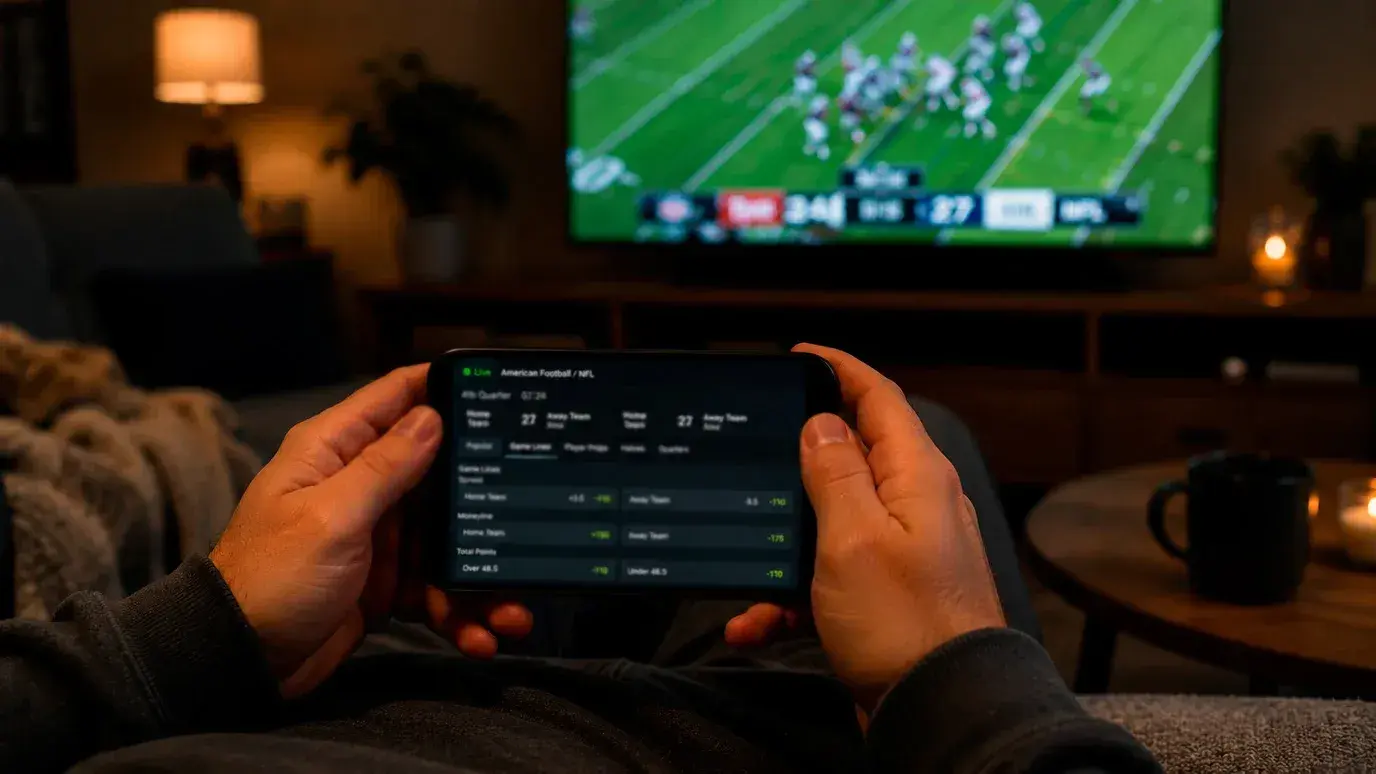
Mobile matters here, too. About 76% of bettors aged 18-24 in the UK place their wagers via mobile phone, and 95% of all online gambling happens from home. That means most NFL bets are placed on a five-inch screen, often late at night when games are in progress. On a small display, the cleaner decimal format is easier to scan. If you are comparing in-play odds across two apps during a Monday Night Football game, decimal gives you a faster read.
Sarah Chen, a compliance director at a major UK gambling company, noted that the industry is going through a fundamental shift in how operators approach customer relationships — moving from reactive harm prevention toward predictive financial protection. Part of that shift involves how information is presented, including odds. Some operators are testing formats that show implied probability alongside the numeric odds, giving bettors a clearer picture of what the price actually means. It is a small change, but directionally it favours the informed bettor.
Whichever format you choose, the substance does not change. A bet at 5/2, 3.50, or +250 pays exactly the same amount. The format is a lens, not a lever. Pick the lens that lets you see most clearly, and stick with it.
Why NFL Odds Move and What It Signals
Last October, I watched a Week 7 NFL spread open at -3 on a Tuesday and close at -6 by Sunday morning. No injury report, no weather event, no breaking news. Just money. Enough of it, flowing in one direction, to move the number three full points in four days. If you did not understand why that happened, you were betting blind.
NFL odds move for two reasons: information and money. Information includes injury updates, inactive lists, weather forecasts, and depth chart changes. Money includes the volume and direction of wagers placed by both the public and sharp bettors. Bookmakers adjust their prices to balance exposure — they do not want to be overloaded on one side of a game — and to reflect new information that changes the probability of an outcome.
Always ensure you are comparing these odds across a trusted UK online NFL betting platform to guarantee the highest possible returns.
The NFL handles roughly $30 billion in legal wagers per season across US-licensed operators alone, and UK books add their own volume on top. That liquidity is enormous, and it means NFL lines are among the most efficient in all of sports betting. By “efficient” I mean that the closing line — the final price just before kickoff — tends to be a very accurate reflection of each team’s true chance of winning. The market aggregates the knowledge of thousands of bettors, many of them professionals, and the result is a price that is hard to beat.
This has a direct implication for timing. Early in the week, lines are softer. They reflect the bookmaker’s opening assessment, which has not yet been tested by sharp action. As the week progresses, money flows in, information clarifies, and the line sharpens. By Sunday at 6 PM UK time, the price is at its most accurate — and therefore at its hardest to exploit.
What should a UK punter do with this knowledge? First, pay attention to line movement, not just the current price. If a line moves from -3 to -4.5, something has changed. Maybe the starting quarterback is doubtful. Maybe a syndicate has taken a position. Either way, the movement is a signal worth investigating before you bet. Second, recognise that odds movement on NFL games tends to be sharper and faster than on Premier League matches, because the NFL market attracts a disproportionate share of sophisticated money. Third, if you have a strong opinion on a game, placing your bet early in the week often gets you a better number — but only if your opinion is based on analysis, not instinct.
Odds movement is not noise. It is the market speaking. Learning to listen to it — rather than just looking at the final price — is one of the clearest edges available to any bettor, regardless of experience level.