
The bet that taught me the most about live NFL wagering was one I almost did not place. Fourth quarter, Week 14, a team trailing by 17 with eight minutes left. The in-play moneyline had them at roughly 14/1. I watched the next three drives — two turnovers forced, a quick-strike touchdown, an onside kick recovered — and the price collapsed to 3/1 before I could blink. I did not get in at 14/1. I got in at 5/1 after the second turnover, and it still paid handsomely when the comeback landed. That sequence taught me something no pre-game analysis ever could: NFL games do not unfold in a straight line, and the bettor who reads the inflection points in real time has an advantage that disappears the moment the broadcast catches up.
In-play betting now accounts for 62.35% of online wagering revenue globally, and the format is growing at a compound annual rate close to 14%. NFL is one of the sports driving that growth, because the stop-start rhythm of American football — huddle, snap, play, reset — creates natural windows for odds recalculation that continuous-flow sports like football or basketball do not offer. For UK punters, live NFL betting carries a unique challenge: most games kick off between 6 PM and 1:20 AM British time, which means decision-making happens during the evening hours when focus can waver. This guide covers the markets, the timing, and the mental discipline you need to make in-play work for you rather than against you.
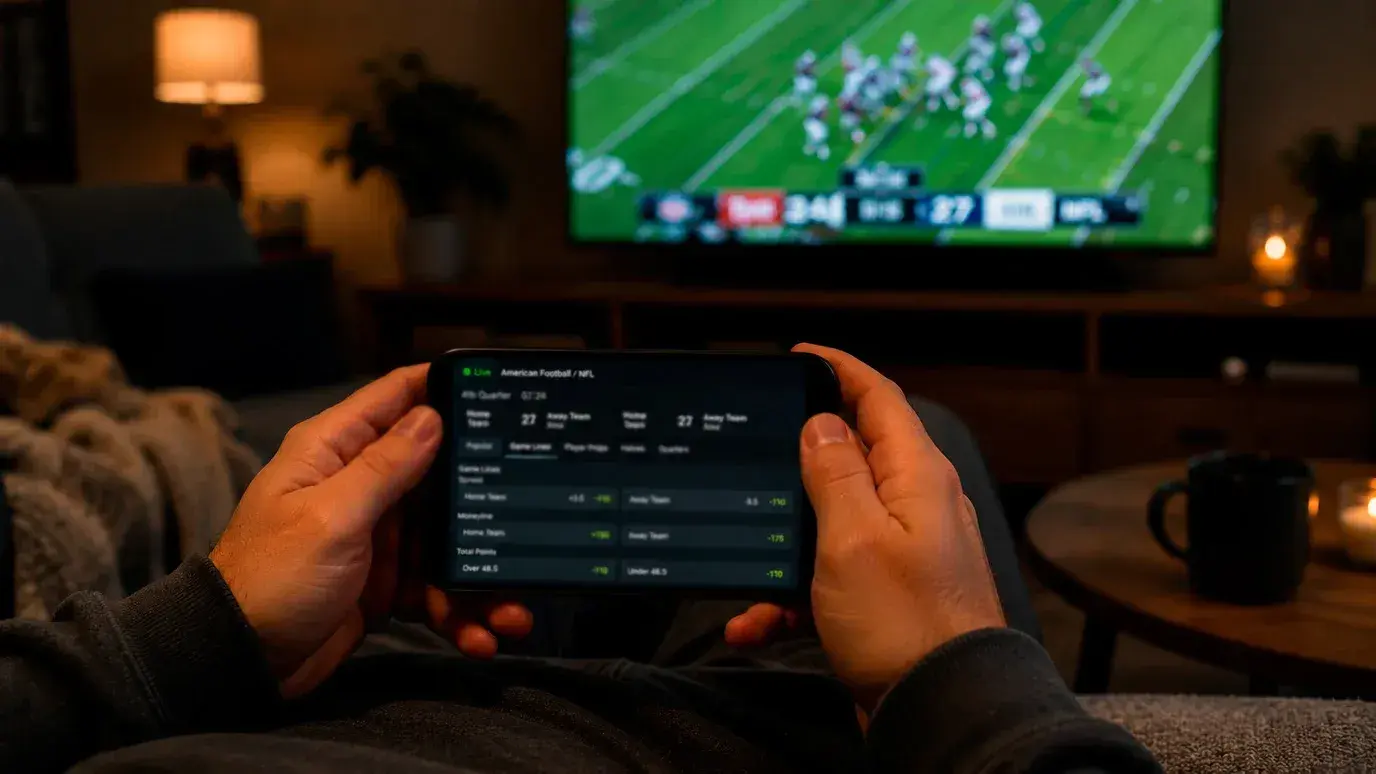
Because live odds fluctuate rapidly between plays, utilizing highly responsive mobile NFL betting apps is crucial for locking in the best numbers.
In-Play NFL Markets Available to UK Bettors
Not every in-play market is created equal, and not every market available pre-game stays open once the ball is kicked. Knowing what is on the board — and what disappears — saves you from scrambling mid-game when you should be watching the field.
The core live markets on most UKGC-licensed platforms mirror the pre-game big three: moneyline (match result), point spread, and total points (over/under). These remain open throughout the game and update after every significant play — a touchdown, a turnover, a field goal, sometimes even a big first down. The odds recalculate based on the current score, time remaining, and field position. A team leading by 10 at halftime will have a much shorter moneyline than they did at kickoff, because the market now factors in the cushion.
Beyond the big three, UK platforms typically offer next scoring play (touchdown, field goal, safety), next team to score, quarter betting (winner and total points for each quarter individually), and drive result (touchdown, field goal, punt, turnover). Some of the larger operators extend their in-play menus to include player props — next player to score a touchdown, passing yards in the current quarter — though these tend to have wider margins and slower refresh rates.
About 95% of UK online gambling takes place from home, and 76% of bettors in the 18-24 age bracket use their phones. That mobile-first reality shapes what in-play markets you can access practically. On a phone screen, the full depth of an NFL in-play board can be overwhelming. I recommend bookmarking two or three markets you understand well — say, live spread, live total, and next scoring play — and ignoring the rest during the game. Depth of market is only useful if you can process it fast enough to act on it.
One market worth special attention is the alternate live spread. Some platforms allow you to choose a live spread that differs from the current main line, at adjusted odds. If the main live spread is -3.5 and you believe the favourite will win by a touchdown or more, you can take -6.5 at a longer price. This is where conviction meets opportunity, and it is a tool that experienced in-play bettors use regularly.
Quarter-by-Quarter: When In-Play Value Appears
Ask ten NFL bettors when the best time to bet live is, and you will get ten different answers. After tracking hundreds of in-play positions over the years, I have settled on two windows that consistently offer more value than the rest: the first few minutes of the second quarter, and the midpoint of the third quarter.
The second-quarter window works because of how markets react to the opening fifteen minutes. If a team scores a quick touchdown on their opening drive, the live odds overcorrect. The favourite’s price drops sharply, the underdog’s price balloons, and the market behaves as if the first seven points have decided the game. They have not. One opening-drive touchdown in a 60-minute game is a data point, not a verdict. If the team that scored has a history of slow second quarters, or if the opponent’s defence tends to tighten after the first series, the overcorrection creates value on the trailing side. This is not a guaranteed edge — nothing in betting is — but it is a repeatable pattern that rewards patience.
The third-quarter window is different. Halftime adjustments are a real phenomenon in the NFL. Coaching staffs have fifteen minutes to review film, change schemes, and address what went wrong. The market, however, reprices at halftime based primarily on the score and pre-game expectations. It does not fully account for the tactical adjustments that are about to take effect. When a strong coaching staff trails at the half, the third-quarter price on their side often underestimates their true chances of rallying. The first few possessions of the third quarter reveal whether the adjustment worked — and by then, the price may have already moved.
Two windows I tend to avoid: the final two minutes of the first half (too much variance crammed into too little time, and the odds swing wildly on every play) and the final five minutes of the fourth quarter in a close game. Late in a tight game, the market is at its most efficient because everyone is watching, the information is complete, and the prices reflect genuine uncertainty. Finding an edge in that environment is extremely difficult, even for sharp bettors. The value lives earlier, when the market is still digesting incomplete information.
A season-long habit I recommend: pick one of these two windows and study it across eight weeks. Track the live odds at that specific point in twenty or thirty games. See how often the trailing team closes the gap. You will build a feel for what overreaction looks like in real time, and that feel is more valuable than any single bet.
There is also value in understanding what each quarter tends to produce statistically. First quarters in the NFL are often lower-scoring than subsequent quarters, partly because teams are still feeling out their opponent’s game plan. This means first-quarter unders hit at a slightly higher rate than full-game unders — a pattern that some in-play bettors use to their advantage by waiting until the second quarter opens and reassessing the total based on first-quarter pace. If a game that was set at a total of 47.5 has only produced three points in the first quarter, the live total might drop to 41 or 42, but the true pace of the game may still support the original number. That disconnect is where in-play totals become interesting.
Reading Momentum Shifts During an NFL Game
“Momentum” is one of the most overused words in sports broadcasting. Every analyst talks about it, but few define it in terms that a bettor can actually measure. Here is how I think about it: momentum in an NFL game is not vibes. It is a cluster of positive outcomes on consecutive possessions that shifts the probability of the next possession’s outcome.
The clearest momentum signal is a turnover followed by a scoring drive. When a defence forces a fumble or interception and the offence converts the resulting short field into points, the live odds do not just reflect the score change — they reflect a shift in perceived control. The team that just scored off a turnover is now playing with field position advantage, defensive confidence, and crowd energy (or crowd silence, if the road team did it). That cluster of factors tilts the next possession’s probability measurably.
The second signal is consecutive three-and-outs by the same offence. If a team goes three-and-out on two straight possessions in the second half, the market starts pricing in a struggling offence. But — and this is crucial — the market does not always distinguish between a schematic problem and a fluky sequence. Sometimes a good offence faces two difficult third-and-longs due to penalties or bad luck, not because the defence solved them. Watching the plays themselves, rather than just the outcomes, is the difference between reading momentum and reading a scoreboard.
NFL regular season games averaged 18.7 million viewers per game in 2025, and the broadcast coverage has never been better at showing replays, formation analysis, and sideline reactions. Use that information. If a team’s best receiver limps off the field and returns two plays later at reduced speed, the broadcast will show it before the injury report updates. The live odds may not adjust until the player’s next target, giving you a window to act.
A word of caution: momentum is real, but it is also temporary. NFL teams are professionals. A team that gives up 14 unanswered points in the third quarter can stabilise in the fourth. Chasing momentum — betting the hot team because they “feel” unstoppable — is one of the most common errors in live betting. The edge is not in riding momentum blindly; it is in identifying when the market has overpriced momentum and betting the other way.
Late-Night Kickoffs: Managing NFL Live Betting Across UK Time Zones
The NFL schedule is designed for American audiences, and British punters pay a time-zone tax that nobody talks about enough. Sunday early games kick off at 6 PM UK time — perfectly civilised. Sunday late games start at 9:05 PM or 9:25 PM. Sunday Night Football begins at 1:20 AM on Monday morning. Monday Night Football kicks off at 1:15 AM on Tuesday. Thursday Night Football starts at 1:20 AM on Friday. If you are serious about live betting the full NFL slate, you are committing to regular late nights and early mornings across a five-month season.
More than 6 million viewers watched the NFL London Games in 2025 across TV and online — a record for the international series — and those games kicked off at civilised afternoon hours. But London Games account for just three or four fixtures per season. The remaining 260-plus regular season games follow the American schedule, and for live betting purposes, that means you are making decisions between 6 PM and 4 AM UK time.
Jamie Reynolds, a UK-based sports marketing consultant, has observed that British fans are less tribal than American ones — they often follow multiple teams rather than committing to a single franchise. That flexibility is useful for live betting because it means UK punters are more likely to watch games objectively, without the emotional attachment that distorts decision-making. The downside is the temptation to stay up for “just one more game,” which is where the late-night risk emerges.
My practical approach: I pick my live betting games before the day starts. Sunday, I will typically watch the 6 PM window and one game from the 9 PM window. The 1:20 AM slot is reserved for games where I have identified a specific pre-game angle that I want to verify in real time before committing. If I do not have a defined reason to be awake at 2 AM, I am not awake at 2 AM. This is not discipline for its own sake — it is risk management. Tired bettors make worse decisions, and worse decisions compound over a season.
UK Platform Features for NFL In-Play: Cash Out, Alerts and Speed
Three platform features separate a usable NFL in-play experience from a frustrating one: cash out, live alerts, and odds refresh speed. Not every UK operator excels at all three, and the differences matter more for American football than for Premier League betting because of the stop-start rhythm of the game.
Cash out allows you to close a bet before the game ends, locking in a profit or limiting a loss based on the current in-play odds. For NFL, where a 14-point lead can evaporate in two possessions, cash out is a genuine risk-management tool. The catch: cash-out prices are calculated by the bookmaker and include a margin. You will almost never get the “fair” price. The bookmaker takes a cut for offering you the exit, and that cut varies between platforms. I use cash out sparingly — mainly when I have a live bet that has moved heavily in my favour and I no longer have a strong opinion on the remaining game flow.
Live alerts and push notifications are underrated. The best UK apps send real-time score alerts, red-zone notifications, and turnover updates. If you are following a game from your sofa without a broadcast (perhaps the 1 AM Thursday game is not on any channel you have), alerts give you the skeleton of what is happening. Paired with a live stats feed, you can piece together enough information to make informed in-play decisions. The UK sports betting market generates billions in annual gross gambling yield across all channels, and a growing share of that comes from bettors who interact with games primarily through their phone rather than a TV screen.
Odds refresh speed is the most technical factor and the hardest to evaluate without testing. NFL in-play odds should refresh after every significant play — every score, every turnover, every change of possession at minimum. Some platforms suspend betting during the play itself and reopen with updated odds within seconds. Others lag, leaving stale prices on screen for 10-15 seconds. That lag can work in your favour (if you spot a price that has not yet adjusted to a game-changing play) or against you (if your bet is rejected because the odds changed before the server processed your slip). There is no universal best platform for refresh speed; it depends on server load, traffic, and the specific game. If you plan to bet in-play seriously, test two or three platforms during a same game parlay or single-market session and note which ones feel fastest.
In-Play Discipline: Avoiding Impulse Bets at 2 AM
I will say something that no betting guide wants to say: in-play NFL betting is, for most people, a net negative activity. Not because the markets are rigged or the odds are unfair, but because the format exploits the exact cognitive weaknesses that late-night decision-making amplifies. The dopamine hit of a correct live call is immediate. The pain of a bad one arrives just as fast. The cycle accelerates, and before you know it, you have placed eight in-play bets in a single game when your pre-game plan called for zero.
Roughly 2.7% of UK adults — about 1.4 million people — score 8 or higher on the Problem Gambling Severity Index, a threshold that indicates significant gambling-related harm. That percentage has remained stable in recent years, but the absolute number is large enough to warrant attention. In-play betting, with its rapid feedback loops and constant availability, is a format that carries elevated risk for anyone prone to impulsive decision-making.
Before participating in fast-paced live markets, make sure you have an active account with a top-rated British American football bookmaker.
My rules for in-play discipline are rigid, and I do not bend them regardless of how the game is going. First, I set a session limit before kickoff: a maximum number of in-play bets per game, usually two. Second, I never bet in-play on a game where I have already lost a pre-game bet — the temptation to “get it back” live is the single most destructive impulse in betting. Third, I do not bet in-play after midnight unless I have a documented, specific reason written down before the game started.
These rules are not theoretical. They are the product of watching my own behaviour and noticing when my decisions deteriorated. The patterns are predictable: tiredness increases risk tolerance, losses increase chasing behaviour, and the availability of instant markets makes acting on both impulses effortless. If you recognise these patterns in yourself, the most valuable tool is not a betting strategy — it is a deposit limit set on your account, combined with a session timer on your phone. Every UKGC-licensed platform offers deposit limits, and most offer session reminders. Using them is not a sign of weakness; it is a sign that you take your bankroll seriously.