
The question comes up every September, usually from someone who has just discovered that American football is available on every major UK betting platform: is it actually legal to bet on NFL games from the UK? The short answer is yes. The longer answer involves a regulatory framework that is among the most comprehensive in the world, a licensing system that covers every sport regardless of where it is played, and a set of rules that changed substantially in 2025 and 2026. Ten percent of UK adults actively bet on sport online, and every one of them is protected—or at least should be—by the same legal structure that governs NFL wagering.
This guide covers how UK gambling law applies to American sports, what separates licensed from unlicensed operators, and what obligations you carry as a bettor when you open an account and place your first NFL wager.
How UK Gambling Law Applies to American Sports
UK gambling law does not distinguish between domestic and international sporting events. The Gambling Act 2005, which remains the foundational legislation, authorises licensed operators to offer betting on any sport, anywhere in the world. Whether you are betting on a Premier League match at Anfield or a Monday Night Football game in Kansas City, the legal framework is identical. The sport’s country of origin is irrelevant; what matters is that the operator holding your bet is licensed by the UK Gambling Commission.
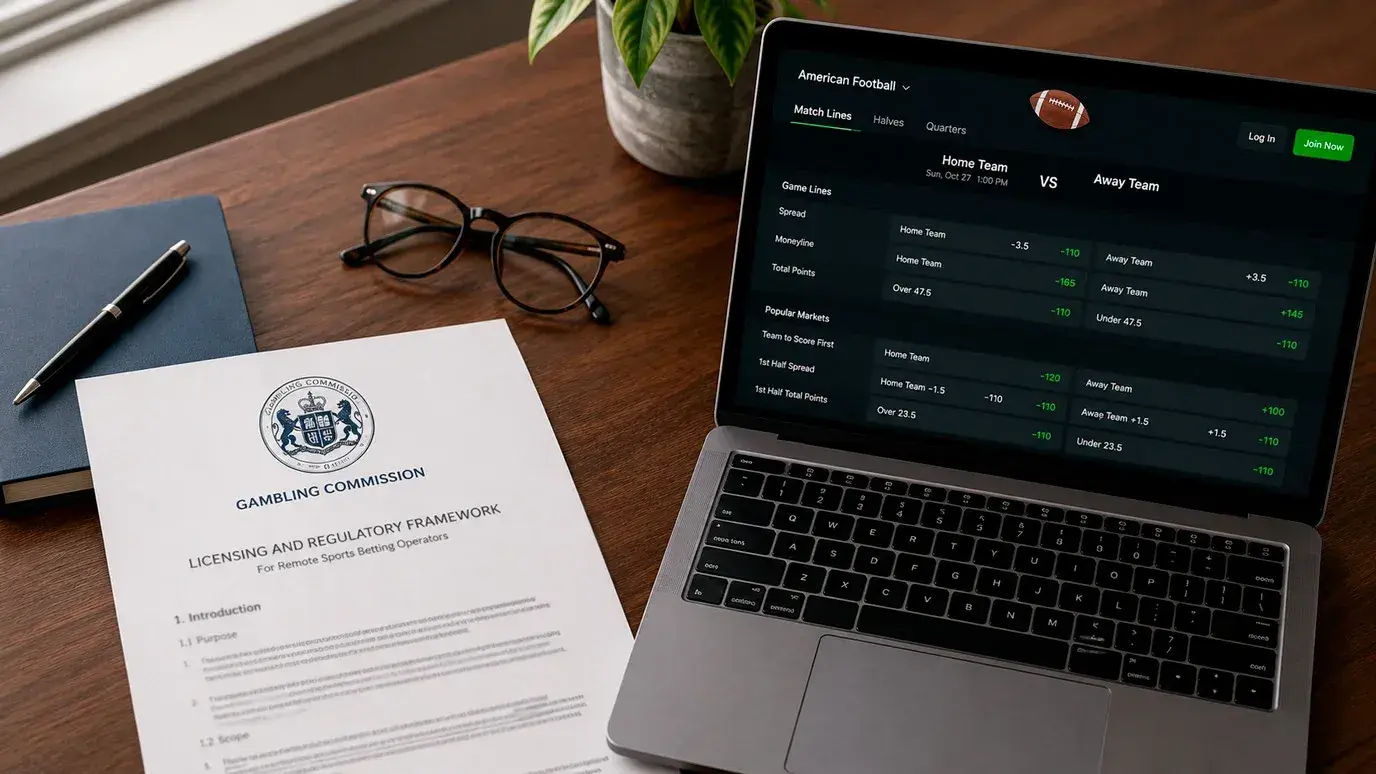
The UKGC issues licences to operators that meet its requirements for financial stability, software integrity, customer protection, and responsible gambling protocols. Any operator offering betting services to UK consumers must hold a UKGC licence, regardless of where the company is headquartered. This means a Malta-based operator serving UK customers still falls under UKGC jurisdiction for those customers—a detail that is frequently misunderstood.
The regulatory environment tightened significantly in 2024-2025. The UKGC carried out 9,700 compliance actions during the 2024/2025 financial year, more than double the 4,200 actions recorded in the previous year. That escalation reflects a regulator that is actively enforcing its rules, not passively collecting licence fees. For NFL bettors, this means the platforms you use are under more scrutiny than ever, which translates into stronger consumer protections—even if it occasionally means more friction during account verification or deposit processes.
One common misconception: betting on the NFL does not require any special permission, additional registration, or separate account. If you have a verified account with a UKGC-licensed operator, you can bet on any sport they list, including the NFL, NCAA football, and any other American sport in their market catalogue.
Licensed vs Unlicensed Operators: The Risk of Offshore Sites
UK bettors placed approximately 2.7 billion pounds with unlicensed operators during 2024-2025. The black market’s share of total UK betting has grown from 2% in 2022 to 9% today—a fourfold increase that reflects both the appeal of fewer restrictions and the growing awareness of offshore alternatives.
The appeal is understandable. Unlicensed operators often offer higher deposit limits, no affordability checks, wider promotional offers, and access to markets that UKGC-regulated platforms may restrict. For NFL betting specifically, some offshore sites offer a larger selection of props, higher maximum stakes on spreads, and odds that appear marginally better than their UK-regulated equivalents.
What they do not offer is protection. An unlicensed operator has no legal obligation to pay out your winnings, no requirement to segregate customer funds, no dispute resolution mechanism, and no obligation to honour any terms they advertise. If the site closes, your funds are gone. If they void a winning bet citing a vague clause in their terms, you have no regulator to escalate to. If your personal and financial data is compromised, you have no recourse under UK data protection law because the operator sits outside its jurisdiction.
I have seen this play out firsthand. A fellow bettor used an offshore platform for NFL futures and had a 500-pound winning ticket voided on a technicality that would never stand under UKGC rules. There was nothing he could do. The 500 pounds was simply gone. The marginal improvement in odds or deposit flexibility never compensates for the total absence of legal protection.
What UK Bettors Need to Know: Age, ID and Deposit Limits
Andrew Rhodes, the UKGC’s chief executive, has repeatedly emphasised the importance of understanding gambling risk profiles, urging operators to use survey evidence to assess the risks within their customer bases. That regulatory philosophy shapes the onboarding process for every UK bettor.
You must be 18 or older to place a bet in the UK. Age verification is mandatory before you can deposit or wager, and operators are required to verify your identity using official documentation—typically a passport or driving licence. Most platforms complete this electronically within minutes, but if the automated check fails, you will need to upload documents manually.
Since February 2026, affordability checks apply to all UKGC-licensed operators. The threshold is 150 pounds net loss per month for initial “frictionless” checks, which run in the background using credit reference data. Around 95% of these checks resolve without any interruption to your betting. If your losses exceed the threshold, the operator may request further documentation—payslips, bank statements—to verify that your gambling is affordable. The full mechanics of how these checks work, and what triggers the enhanced stage, are covered in the affordability checks guide.
Deposit limits are set by you, not by the operator. Every UKGC-licensed platform offers daily, weekly, and monthly deposit caps that you configure during or after registration. Setting these limits is optional but strongly recommended. Once set, increasing them requires a 24-hour cooling-off period—a deliberate friction designed to prevent impulsive decisions.
GamStop and Self-Exclusion for NFL Bettors
GamStop is the UK’s national self-exclusion scheme. If you register with GamStop, you are blocked from all UKGC-licensed gambling sites for a period of your choosing: six months, one year, or five years. The registration is free, takes a few minutes, and applies across every licensed operator simultaneously.
Self-exclusion is not reversible during the chosen period. If you sign up for a one-year exclusion in August, you will not be able to bet on the NFL at all during that season—and that is the point. GamStop is designed for people who recognise that their gambling has become harmful and want a definitive break without the option to relent.
Operators are required to enforce GamStop exclusions. If a self-excluded person manages to open a new account (using different details, for instance) and the operator fails to detect it, the operator faces regulatory action. This enforcement obligation is another protection that only applies to licensed platforms—offshore operators have no connection to GamStop and will happily accept bets from excluded individuals.
For NFL bettors who want a less drastic tool, most UKGC platforms offer individual self-exclusion (from that specific operator only), session time limits, and reality checks that display how long you have been logged in and how much you have wagered. These tools are available in the account settings of every licensed app and website, and using them is a sign of discipline, not weakness.