
The NFL regular-season audience averaged 18.7 million viewers per game in 2025—the second-highest figure in the sport’s history—and a meaningful share of those viewers watched games played in conditions that would cancel most outdoor events. Snow in Buffalo, 30 mph winds in Chicago, freezing rain in Green Bay. These are not freak occurrences; they are scheduled into the calendar every December and January, and they affect scoring in ways that the betting market sometimes prices correctly and sometimes does not.
I have been logging weather data against game totals for seven seasons, and the patterns are consistent enough to act on. This guide covers the specific weather thresholds that matter for NFL totals, what the scoring data shows for cold-weather games, and when the market underreacts to conditions that should move the number.
Wind Speed Thresholds: Impact on Passing Games
Wind is the most impactful weather variable for NFL totals, and it operates on a threshold rather than a gradient. Below 15 mph sustained, wind has negligible effect on scoring. Between 15 and 20 mph, passing accuracy decreases and punt/kick distances become inconsistent, but offences can still function. Above 20 mph sustained, the passing game collapses. Deep routes become unreliable, field goal accuracy drops sharply beyond 40 yards, and teams shift to run-heavy game plans that shorten drives and reduce scoring opportunities.
The market adjusts totals for wind, but my observation is that it under-adjusts when winds are forecast at 18-22 mph—the range where the effect is real but does not look extreme on a forecast. At 25+ mph, the adjustment is usually adequate because the conditions are dramatic enough to attract media attention and public awareness. It is in the 18-22 mph band where the under carries the most consistent edge.
One nuance: wind direction matters relative to the stadium orientation. A stadium where the field runs north-south will be affected differently by a westerly wind than an easterly one. End-zone crosswinds are more disruptive than headwinds or tailwinds because they affect every passing route and every kick, whereas a headwind primarily affects deep balls and kicks in one direction. I check wind direction against stadium orientation for every outdoor game during Weeks 12-18, when cold-weather stadiums become the primary battleground.
Gusts are a separate factor. A forecast showing 15 mph sustained with gusts to 30 mph creates unpredictable conditions that are worse for scoring than a steady 20 mph wind. Quarterbacks can adjust their mechanics for consistent wind; intermittent gusts catch them mid-throw. When the gust differential (peak gust minus sustained speed) exceeds 10 mph, I treat the game as a wind-affected total regardless of the sustained figure.
Cold-Weather Games: What the Scoring Data Shows
Cold alone does not suppress NFL scoring as much as casual observers assume. Players wear heated gloves, heated benches line the sidelines, and modern football equipment is designed for extreme temperatures. The scoring data shows a modest decline in games played below 0 degrees Celsius, but the effect is far smaller than wind’s impact.
Where cold becomes significant is in combination with other factors. Cold plus wind creates a wind-chill effect that stiffens hands, reduces grip on the ball, and makes receivers less willing to extend for contested catches. Cold plus precipitation—freezing rain or snow—creates surfaces that affect footing and increase turnovers. In isolation, cold is a minor variable. In combination, it becomes a meaningful one.
Eighty-nine of the 100 most-watched US television programmes in 2025 were NFL games, and many of the most iconic images from those broadcasts featured games played in extreme cold. The visual drama of a snow game attracts enormous attention, and that attention drives public betting toward the under. The market often overreacts to visually dramatic conditions, pricing the under too aggressively on games where the cold alone does not warrant a large adjustment. My data shows that sub-zero games without significant wind actually go over the total at a rate close to 50%—no edge in either direction.
The edge appears in sub-zero games with wind above 15 mph. In those combined conditions, scoring drops meaningfully, and the total should be 3-5 points lower than a neutral-weather version of the same matchup. If the posted total has only moved 1-2 points from the original line, the under has value.
Rain and Snow: Impact on Footing, Fumbles and Totals
Rain affects NFL games through two mechanisms: a wet ball and a wet surface. A wet ball is harder to throw accurately and harder to catch cleanly. A wet surface reduces traction, which affects both offensive and defensive players but disproportionately impacts offensive skill positions that rely on precise route-running and sudden changes of direction.
Fumble rates increase in rain games, which creates additional unpredictability. A fumble does not always suppress scoring—a fumble recovered by the defence in the opponent’s territory can lead to a short-field touchdown. But fumbles do disrupt offensive drives, and the net effect across a large sample is a modest reduction in total points. I treat moderate-to-heavy rain as worth 1.5-2.5 points on the total, applied toward the under.
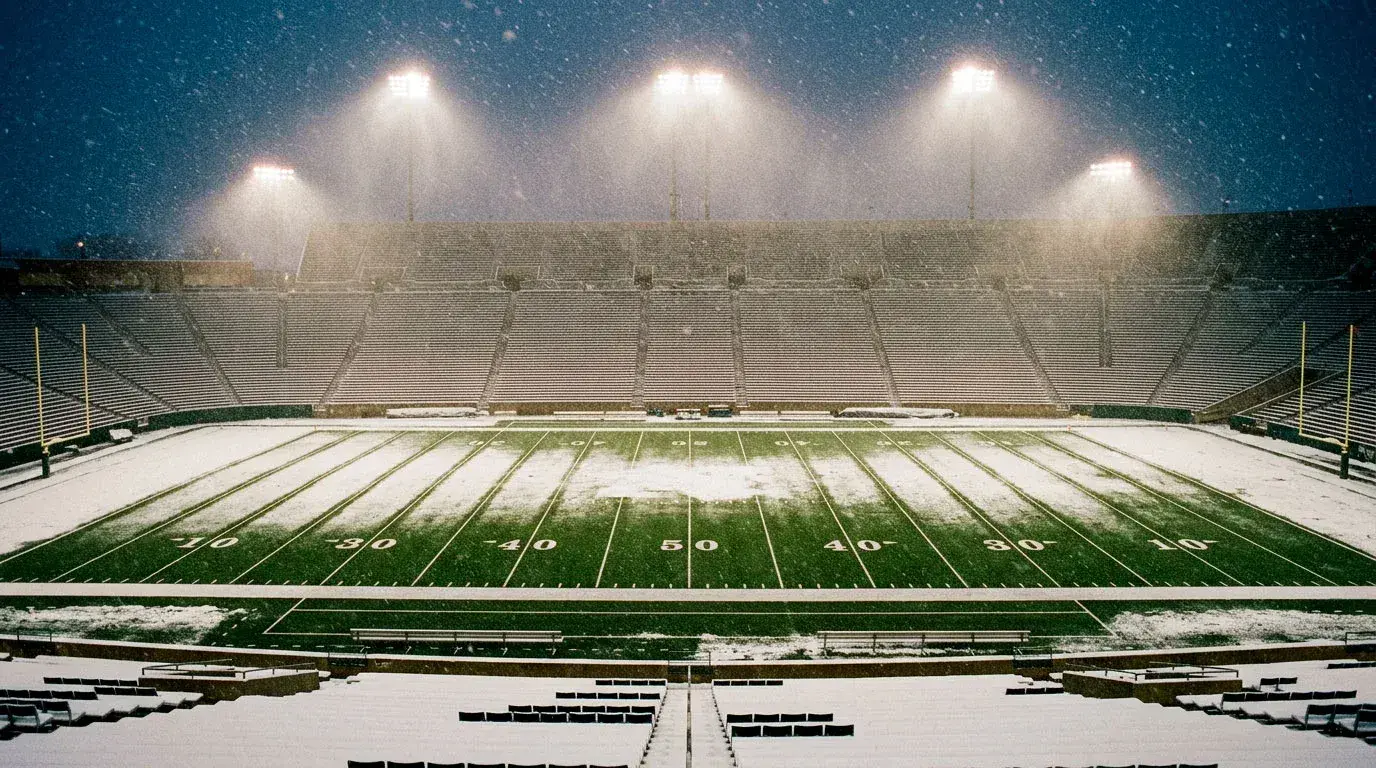
Snow is more complex. Light snow on a grass surface has minimal impact—the footing remains reasonable and the ball stays dry enough to handle. Heavy snow that accumulates on the field changes the game fundamentally: passing becomes unreliable, kicking is compromised, and the running game dominates. These conditions produce low-scoring affairs, but the market typically adjusts the total aggressively for heavy snow because the forecast is newsworthy and visible.
The scenario I look for is light-to-moderate snow that the market dismisses. A forecast of “scattered snow showers” in a late-season outdoor game often produces slippery conditions without the dramatic visual of a blizzard. The total may not move at all, but the scoring environment is meaningfully affected.
Dome vs Outdoor: The Built-In Totals Difference
Eight NFL teams play in fully enclosed domes or stadiums with retractable roofs. Games in these venues are weather-neutral by definition—temperature is controlled, wind is absent, and precipitation is irrelevant. The totals betting guide covers the broader mechanics of how totals are set, but the dome-versus-outdoor distinction deserves specific attention for its effect on seasonal patterns.
Bettors who wager on NFL games watch roughly 19 more games per season than non-bettors, and that additional viewing creates familiarity with how dome games look and feel compared to outdoor December contests. Dome games consistently produce higher totals—the average total in a dome is 2-3 points higher than in an outdoor stadium during the same week. This difference is baked into the opening line, so there is no automatic edge in betting the over on dome games.
The edge appears when an outdoor team travels to a dome, or vice versa. A defence built for outdoor cold-weather football—heavy front, run-stopping emphasis, physical secondary—can struggle in the speed-friendly environment of a dome. Conversely, a dome-based team with a finesse passing attack can look diminished when playing outdoors in December wind and rain. When the matchup creates an environmental mismatch, the total may not fully reflect the adjustment, and that is where value sits.