
I discovered betting exchanges during my third NFL season, and the difference was immediate. Instead of accepting the bookmaker’s price and hoping it was fair, I could set my own price, wait for someone to match it, and trade out of positions during games. The UK sports betting market generates approximately $3.3 billion in annual gross gambling yield, and exchanges capture a small but meaningful slice of that figure—particularly among bettors who want to bet against outcomes, not just for them.
Exchanges operate on a fundamentally different model from traditional bookmakers, and understanding that model is essential before you place your first NFL trade. This guide covers the mechanics, the liquidity reality for American football, and the specific situations where an exchange gives you an advantage that a standard bookmaker cannot.
How NFL Betting Exchanges Differ from Bookmakers
A traditional bookmaker sets the odds, accepts your bet, and pays out if you win. The bookmaker is your counterparty—when you win, they lose, and vice versa. This creates a structural incentive for the bookmaker to manage risk by adjusting odds, limiting stakes on sharp bettors, and building margin (overround) into every market.
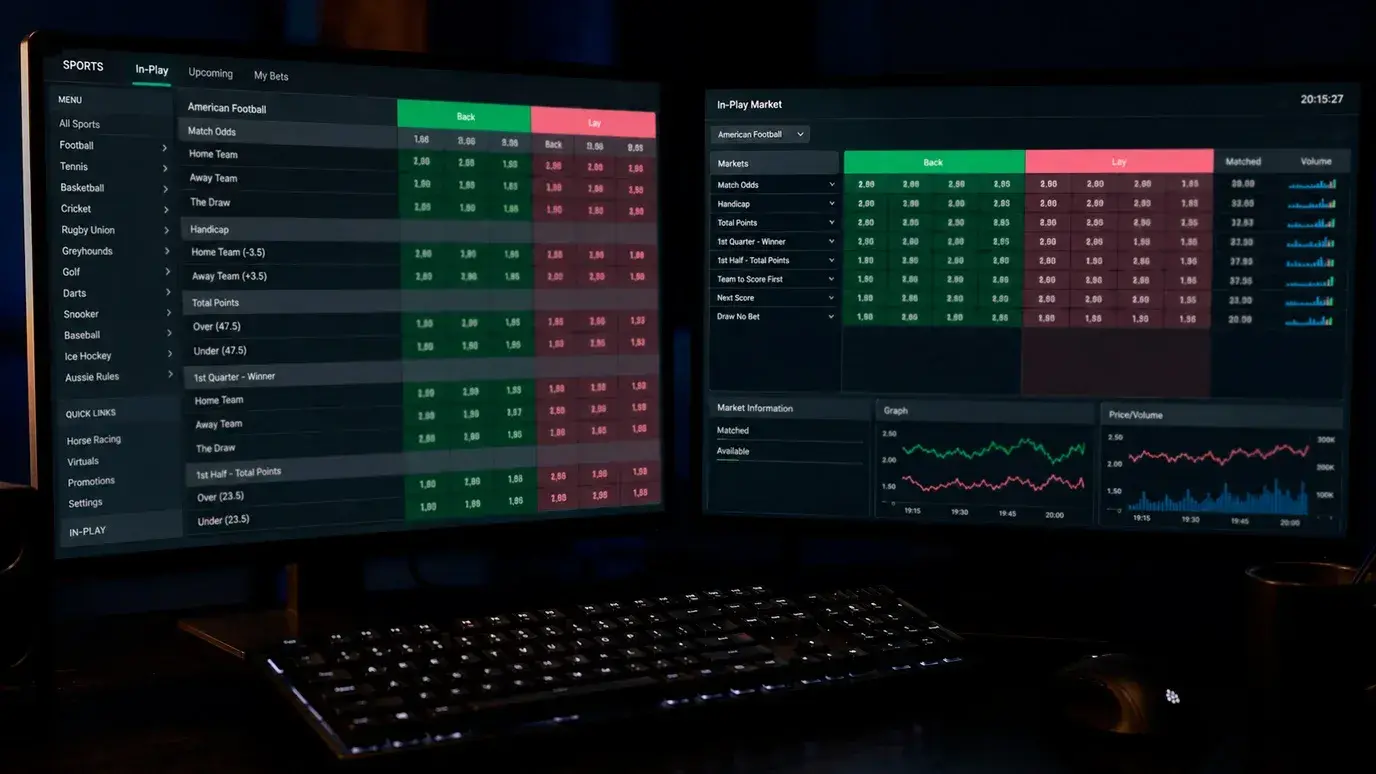
An exchange does not set odds or accept bets. Instead, it provides a platform where bettors trade with each other. You can “back” an outcome (bet that it will happen) or “lay” an outcome (bet that it will not happen). When a backer and a layer agree on a price, the bet is matched. The exchange takes a commission on the winning side—typically 2-5% of the net profit—and has no exposure to the outcome itself.
The absence of overround is the exchange’s primary advantage. On a traditional bookmaker, a two-way NFL market might price Team A at 10/11 and Team B at 10/11, giving a combined implied probability of roughly 105%. The 5% overround is the bookmaker’s built-in margin. On an exchange, the combined implied probability of the back prices is often closer to 101-102%, because the market is set by competing bettors rather than by a bookmaker protecting its margin. That 3-4% difference in overround directly improves your expected return.
The ability to lay is the exchange’s second advantage. Laying means you are betting that something will not happen. If you believe a team is overvalued by the market, you can lay them—effectively acting as the bookmaker for that specific outcome. If they lose, you keep the backer’s stake (minus commission). If they win, you pay out at the agreed odds. This is impossible on a traditional bookmaker, where you can only bet on outcomes, not against them.
NFL Exchange Liquidity in the UK: What to Expect
Here is the honest truth about NFL exchange betting in the UK: liquidity is thin compared to football. The NFL generated $30 billion in US handle during 2025, but the exchange-traded portion of UK NFL betting is a tiny fraction of that. Most UK exchange volume on American football concentrates on three market types: pre-match moneyline, pre-match spread, and Super Bowl outright.
For regular-season moneylines on marquee games—Sunday Night Football, Monday Night Football, and any game featuring teams with large UK followings—liquidity is usually sufficient to place bets of 50-200 pounds without significantly moving the price. For lower-profile early Sunday afternoon fixtures, the available volume can be thin enough that placing a 100-pound bet consumes the entire best price and moves the market.
Spread markets on exchanges are even less liquid. The NFL spread is a binary market (cover or not), and the exchange must attract backers and layers on both sides at a mutually acceptable price. For games where the spread is a consensus number (3, 7, or 10 points), this works reasonably well. For games with half-point spreads or less common numbers, the bid-ask gap can be wide enough to negate the exchange’s overround advantage.
In-play NFL exchange markets are a different story entirely. Liquidity during games is unpredictable—a major play can drain available volume as bettors rush to trade, leaving you unable to match a bet at the price you want. I use exchanges for pre-match NFL betting and traditional bookmakers for in-play, because the liquidity differential during live games makes the exchange unreliable for rapid execution.
Commission Structures: Matchbook vs Betfair
The two primary NFL-carrying exchanges in the UK charge different commission rates, and the difference matters more than most bettors realise. Betfair’s standard commission is 5% of net profit on winning bets, though this can be reduced through their loyalty programme for high-volume traders. Matchbook’s standard commission sits at 2%, which is one of the lowest in the exchange market.
On a 100-pound winning bet at even money, the commission difference is straightforward: Betfair takes 5 pounds, Matchbook takes 2 pounds. Over a season of 50-100 NFL bets, that 3% gap compounds into a meaningful amount. If your average winning bet returns 50 pounds in profit and you win 40 bets across the season, the commission difference is 60 pounds—enough to affect your overall return.
Lower commission does not automatically make Matchbook the better choice, however. Betfair’s liquidity on NFL markets is generally deeper because it has a larger user base. A 2% commission on a market where the best available price is 2 ticks worse than Betfair’s may not represent better value overall. The correct comparison is the effective price after commission: if Betfair offers 1.95 back minus 5% commission versus Matchbook at 1.93 back minus 2%, you need to calculate the net return on each before deciding.
I maintain accounts on both platforms and route each bet to whichever offers the better net price after commission. This requires checking both before placing, which adds a few minutes per bet but has consistently improved my seasonal return.
When an Exchange Beats a Traditional Bookmaker for NFL
The exchange advantage is largest in three specific scenarios. The first is moneyline betting on moderate underdogs. Traditional bookmakers build wider margins into underdog prices because recreational bettors rarely bet them, giving the bookmaker less incentive to sharpen the line. On an exchange, the underdog price is set by market participants, and competition between layers often produces a price 5-10% closer to the true probability. Live and in-play betting accounts for 62.35% of global online betting revenue, but for pre-match underdog moneylines, the exchange is consistently the better venue.
The second scenario is laying outcomes. If you believe a team’s futures price is too short—say, a hyped contender at 5/1 to win the Super Bowl when your assessment puts them at 10/1—the exchange lets you lay that team and profit if they do not win. No traditional bookmaker offers this. Laying futures is a core strategy for sophisticated NFL bettors, and the exchange is the only venue where it is possible.
The third scenario is trading positions during the season. If you backed a team to win the Super Bowl at 20/1 pre-season and their odds have shortened to 6/1 by Week 12, you can lay them on the exchange at 6/1 and lock in a guaranteed profit regardless of whether they win the championship. This “green book” approach is impossible with a traditional bookmaker unless they offer a cash-out at a competitive price, which is not guaranteed. The odds explained guide covers how to calculate implied probabilities, which is essential for evaluating exchange trading opportunities.