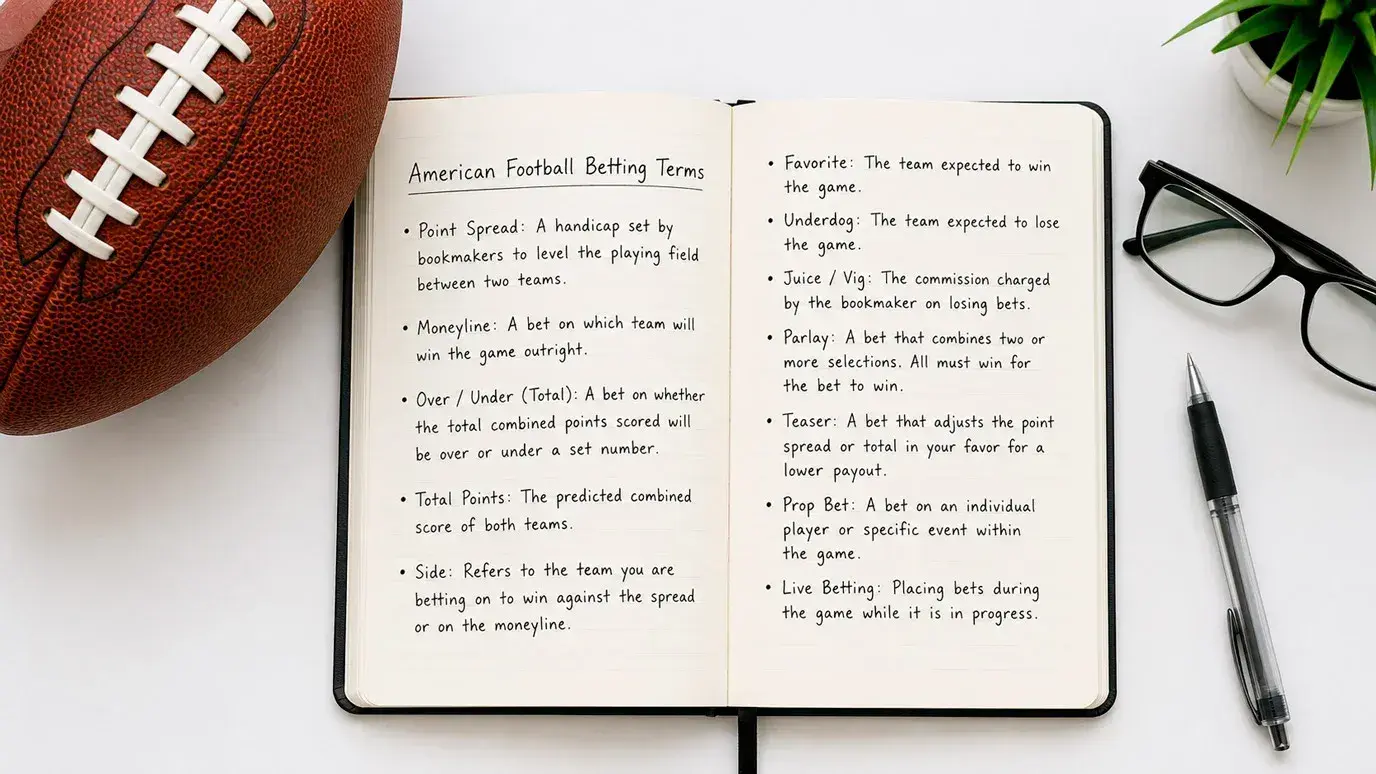
The NFL has 14.3 million fans in the UK, and a growing number of them are placing bets on a sport whose terminology was built for an American audience. The result is a jargon collision. UK punters understand “accumulator” and “each way.” American bettors think in “parlays” and “teasers.” When you read an NFL betting discussion online, half the vocabulary may be unfamiliar even if you have been betting on football your entire life.
This glossary covers more than 60 NFL betting terms, defined in British betting context with examples drawn from actual NFL scenarios. It is organised alphabetically in three sections, followed by a translation table mapping US terms to their UK equivalents.
A–F: ATS, Chalk, Cover, Edge, Fade, Futures
Action — any bet that is live and has not yet been settled. “I have action on the Chiefs” means you have an open bet on Kansas City.
Against the spread (ATS) — a team’s record relative to the point spread, not their actual win-loss record. A team that is 8-3 ATS has covered the spread in eight of eleven games, regardless of how many they won outright.
Bankroll — the total amount of money you have allocated for betting. Not your bank balance; your designated betting fund.
Bad beat — a bet that loses due to a late, unexpected event. A spread bet that was covering comfortably until a meaningless touchdown in the final minute is a bad beat.
Chalk — the favourite. “Betting the chalk” means backing the favoured team. Derived from the days when odds were written in chalk on a board.
Closing line — the final odds available before kickoff. The closing line is considered the most accurate reflection of a game’s true probabilities because it has absorbed the maximum amount of market information.
Cover — winning against the spread. If a team is favoured by 7 and wins by 10, they covered. If they win by 3, they did not.
Dead money — salary cap charges for players no longer on a team’s roster. Relevant to betting because high dead money reduces roster quality at depth positions.
Dog — short for underdog. The team expected to lose. On the spread, the dog receives points; on the moneyline, the dog has longer odds.
Edge — a bettor’s advantage over the bookmaker. If you believe the true probability of an outcome exceeds the implied probability of the odds, you have an edge.
Exotic — any bet outside the standard spread, moneyline, and total markets. Player props, first touchdown scorer, and novelty bets are all exotics.
Fade — to bet against. “Fade the public” means betting opposite to the side the majority of recreational bettors favour.
Favourite — the team expected to win. Indicated by a minus sign on the spread (-7) and shorter odds on the moneyline.
Futures — bets on outcomes decided at the end of a season or tournament. Super Bowl winner, MVP, division champion, and regular-season win totals are all futures markets.
G–O: Handicap, Juice, Key Number, Moneyline, Over/Under
Gridiron — the American football field, named for its grid-like yard markings. Also used as a synonym for the sport itself, particularly in the UK.
Handle — the total amount of money wagered on a specific event or across a specific period. Around 10% of UK adults actively bet on sport online, and the handle they generate collectively shapes market liquidity.
Handicap — the UK term for point spread. A -3 handicap on a favourite is identical to a -3 point spread. Both mean the team must win by more than 3 for the bet to pay.
Hold — the percentage of total handle that the bookmaker retains as profit. A 10% hold means the bookmaker keeps 10 pence of every pound wagered after paying winners.
Hook — a half-point added to a spread or total. A line of 3.5 is “3 with a hook.” The hook eliminates pushes and can be the difference between a win and a loss on key numbers.
In-play — bets placed after a game has started. Also called live betting. Odds update continuously based on the game state.
Juice — the bookmaker’s commission built into the odds. Also called vig or vigorish. On a standard -110 American line (10/11 fractional), the juice is the extra 10% you must risk above your potential profit.
Key number — a margin of victory that occurs more frequently than others. In the NFL, 3 (field goal) and 7 (touchdown with extra point) are the primary key numbers. Spreads on or near key numbers carry special significance.
Laying points — betting the favourite on the spread. If you back the Chiefs at -7, you are laying 7 points.
Limit — the maximum stake a bookmaker will accept on a single bet. Limits vary by market and by bettor; sharp bettors often face lower limits.
Lock — a bet perceived as a certain winner. In practice, there are no locks in NFL betting. The term survives as slang despite being analytically meaningless.
Moneyline — a bet on which team wins the game outright, with no spread involved. The UK equivalent is “match result” or “to win.”
Mover — a game where the line has shifted significantly from its opening number. A game that opened at -3 and moved to -6 is a mover.
Odds — the price attached to a bet, reflecting the implied probability and the potential payout. Displayed as fractional (5/2), decimal (3.50), or American (+250) depending on your platform settings.
Over/under — a bet on whether the combined score of both teams will exceed or fall below a specified total. Also called the total.
Overround — the bookmaker’s margin, expressed as the amount by which the combined implied probabilities of all outcomes exceed 100%. A 105% book has a 5% overround.
UK vs US: Terms That Mean the Same Thing
The most common source of confusion for UK NFL bettors is encountering American terminology that describes concepts they already understand under different names. Here is the translation layer.
What Americans call a “parlay,” the UK calls an “accumulator” or “acca.” Both describe a multi-leg bet where all selections must win. A “teaser” is a parlay with adjusted spreads—the UK has no direct equivalent term, though some platforms label it an “adjusted handicap acca.” What Americans call “the moneyline,” UK platforms may display as “match result” or “to win the match.”
The “point spread” in the US is the “handicap” in the UK. Both apply a positive or negative adjustment to a team’s final score for betting purposes. “Props” are “specials” or “player markets” on UK platforms. “Juice” or “vig” is the “overround” or “margin” in British betting terminology.
One term that does not translate cleanly: “book.” In the US, “book” or “sportsbook” refers to the betting operator. In the UK, “bookie” or “bookmaker” serves the same function, but “book” alone would more likely refer to a physical book. When NFL analysts say “the book has moved the line,” they mean the sportsbook (operator) has adjusted the odds.