Since January 2026, the maximum wagering requirement on any bonus offered by a UKGC-licensed operator is 10x, and cross-product bonuses are banned. Those two regulatory changes reshaped the promotional landscape for NFL betting in the UK, eliminating the worst predatory structures while forcing operators to compete on genuine value rather than inflated headline figures. The promotions that survived are leaner, more transparent, and—if you evaluate them properly—more useful than what came before.
This guide breaks down the three main types of NFL-specific promotions on UK platforms, explains how each actually works beneath the marketing, and gives you a framework for deciding which ones are worth your time.
NFL Acca Boosts: How Percentage Enhancements Work
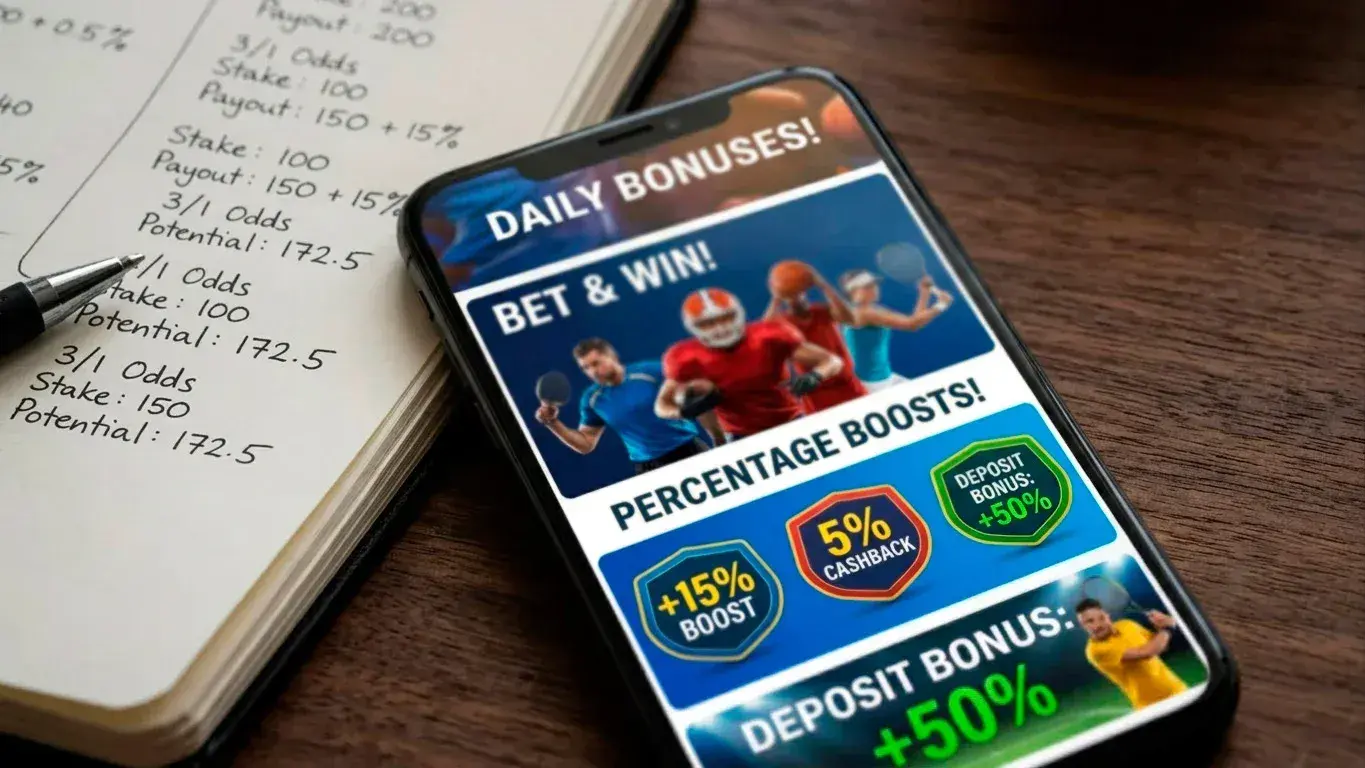
An acca boost adds a percentage uplift to the winnings on your accumulator. The typical structure scales with the number of legs: 5% for two legs, 10% for three, 25% for five, and up to 50% or more for eight-plus legs. The boost applies to the profit portion of the payout, not the stake.
Here is how the maths works in practice. A three-leg NFL acca at combined decimal odds of 4.50 with a 10-pound stake returns 45 pounds total (35 pounds profit plus 10-pound stake). A 10% acca boost adds 3.50 (10% of the 35-pound profit), bringing the total return to 48.50. The boost is real money, but the question is whether 3.50 compensates for the structural disadvantage of accumulators.
Each leg in an accumulator carries the bookmaker’s overround, and those margins compound. A three-leg acca at 5% overround per leg carries an effective combined margin of roughly 15%. The 10% boost offsets some of that compounding—but not all of it. At five legs, the effective margin is around 25%, and a 25% boost brings you roughly back to the margin level of a single bet. Beyond five legs, the boost rarely compensates for the compounding disadvantage.
My rule: treat acca boosts as a marginal improvement on accumulators you would place anyway, not as a reason to build accumulators you would not otherwise consider. The boost improves the maths on bets you have already justified analytically. It does not make a bad acca into a good one.
NFL Odds Boosts and Price Boosts: What’s Actually Enhanced
Odds boosts are the most visually appealing NFL promotion—a specific selection (say, a team to win and the total to go over) is displayed at enhanced odds, often in a prominent position on the homepage. The boosted price looks significantly better than the standard market price, which is the entire point. But the boosted price is not necessarily good value; it is just better than the unboosted version.
The Remote Gaming Duty increase to 40% from April 2026 has compressed promotional budgets, and odds boosts are where that compression is most visible. Operators are offering fewer boosts per week, and the enhancement margin has narrowed. Where a 2024 NFL odds boost might have moved the price from 3/1 to 5/1—a 67% uplift—a 2026 equivalent might move from 3/1 to 4/1, a 33% uplift. The promotion still exists, but the generosity has diminished.
To evaluate an odds boost, compare the boosted price against the true probability of the outcome. If the standard price is 3/1 (implying a 25% chance) and the boosted price is 4/1 (implying a 20% chance), the boost is only valuable if the true probability falls between 20% and 25%. If the true probability is below 20%, even the boosted price does not represent value. The standard price was already bad; the boost just made it less bad.
One structural detail: odds boosts are typically limited to maximum stakes of 10-25 pounds. This cap means they are designed as recreational incentives, not as serious betting opportunities. An odds boost that offers genuine value at 10-pound stakes generates a maximum expected profit of a few pounds—useful as a bonus but not a strategy.
Seasonal NFL Offers: Draft, Week 1, Playoffs, Super Bowl
NFL promotions follow the league’s calendar, and certain windows produce significantly more promotional activity than others. Understanding the cycle helps you time your promotional engagement for maximum value.
The NFL Draft in late April generates the first wave of seasonal offers. Platforms run enhanced odds on first overall pick and first quarterback drafted, often with generous stakes limits because Draft betting handle is relatively low. These promotions represent genuine value more often than regular-season equivalents because the market is less efficient and the operator is using the promotion to attract attention rather than to manage a large liability.
Week 1 of the regular season in September is the highest-intensity promotional period for NFL. Operators compete for NFL bettors’ attention at the start of a five-month season, and the offers reflect that competitive pressure. Free bet bundles, enhanced accumulators, and money-back specials are common. The volume of offers makes comparison difficult, but the framework is the same: calculate the expected value after wagering requirements and conditions, not the headline figure.
Playoff promotions narrow in scope but increase in per-game value. With fewer games to promote, operators concentrate their budgets on individual fixtures, producing deeper boosts and wider free-bet offers on Wild Card, Divisional, and Conference Championship games. The Super Bowl attracts the most aggressive promotional activity of the entire NFL calendar—this is the single event where operators accept the highest promotional losses because the customer-acquisition value is greatest.
How to Evaluate Whether an NFL Promotion Has Real Value
The 10x wagering cap makes evaluation simpler than it was under the old regime, but it does not eliminate the need for calculation. Every promotion has a cost—either an explicit wagering requirement or an implicit one through conditions like minimum odds or restricted markets.
Step one: identify the type. Is it a free bet (SNR or SR), an acca boost (percentage uplift), an odds boost (enhanced price on a specific selection), or a refund offer (money back as cash or free bet if your bet loses)? Each type has a different expected-value profile, and the calculation method differs accordingly. The free bets guide covers the SNR versus SR distinction in detail.
Step two: quantify the conditions. A 20-pound free bet with a 10x wagering requirement and minimum odds of 1/1 per qualifying wager has a calculable expected value based on the overround across 200 pounds of turnover. Do the maths before claiming the offer, not after.
Step three: check NFL eligibility. Not every promotion applies to American football. Some operators restrict certain offers to domestic football, horse racing, or specific leagues. An NFL-specific promotion is only useful if it covers the markets you actually bet on—moneyline, spread, total, player props. A promotion that requires bet builder bets but excludes NFL from its bet builder is worthless for NFL purposes.
The discipline of evaluating promotions before claiming them is the single most profitable habit I have developed over 12 years of NFL betting. The ten minutes spent calculating expected value saves far more money than the promotion itself delivers.