In April 2026, the Remote Gaming Duty—the tax UK operators pay on their gambling revenue—rose from 21% to 40%. That near-doubling sent shockwaves through the industry, and the immediate question from UK bettors was obvious: does this mean I will pay tax on my NFL winnings? The answer is no. Your winnings remain tax-free. But the operators absorbing that 40% levy will find ways to recoup the cost, and understanding how that pressure flows through to odds, promotions, and market availability is essential for anyone betting on the NFL from the UK.
This guide covers why UK betting winnings are not taxed, how Remote Gaming Duty works, what the 40% increase means in practice, and how the UK system compares to the very different tax treatment of sports betting in the United States.
UK Bettors and Tax: Tax-Free NFL Winnings
Since 2001, UK punters have paid no tax on betting winnings. Before that date, bettors faced a 9% duty on their stakes—a system that pushed many toward offshore operators. The Labour government eliminated the betting duty and replaced it with a tax on operators’ gross profits, reasoning that taxing the supply side rather than the demand side would keep betting onshore and within the regulatory framework.
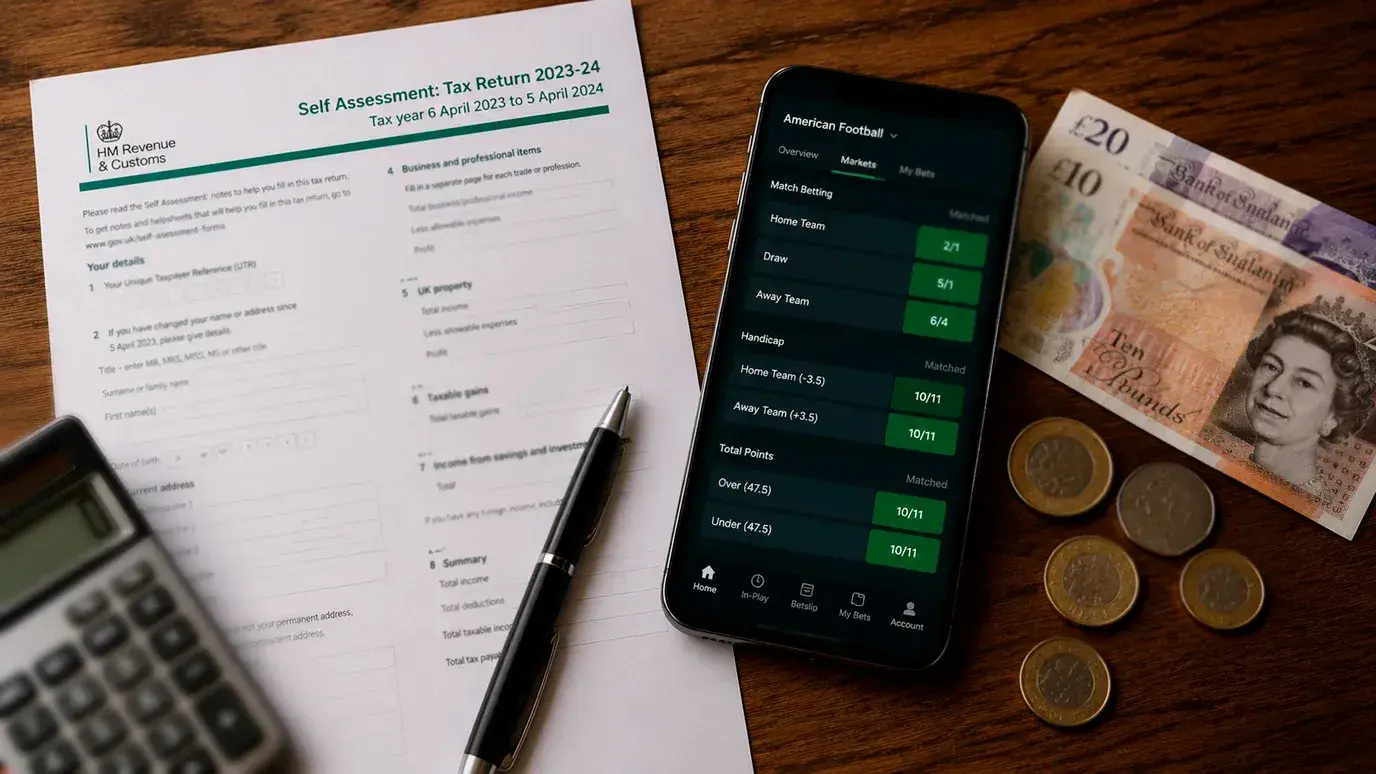
The UK sports betting market generates approximately 16.8 billion pounds per year in gross gambling yield, and not a penny of that is collected from individual bettors. Whether you win 50 pounds on an NFL moneyline or 50,000 on a Super Bowl futures bet, the amount is yours. You do not declare it on your self-assessment tax return. You do not pay capital gains tax. You do not pay income tax. The winnings are not considered income or capital gains under HMRC’s definitions.
This applies regardless of frequency. A professional-level bettor who generates consistent annual profits from NFL wagering is in the same tax position as a casual punter who places one bet per season. HMRC has historically taken the view that gambling winnings are not taxable because they arise from chance rather than from employment or business activity—even when significant skill is involved in the selection process.
One caveat: if you operate as a tipster service, selling betting advice for a fee, the income from your tipster business is taxable as self-employment income. The distinction is between your personal betting profits (not taxable) and your business income from advising others (taxable). The two are separate activities with separate tax treatments.
Remote Gaming Duty: The Tax Operators Pay Instead
Remote Gaming Duty is levied on operators’ gross gambling revenue—the difference between the total amount staked by customers and the total amount paid out as winnings. When a UKGC-licensed operator takes 100 pounds in NFL bets and pays out 92 pounds in winnings, the 8 pounds in gross revenue is the base on which RGD is calculated.
From April 2026, the rate is 40%. On that 8-pound gross revenue, the operator pays 3.20 pounds in RGD. The previous rate was 21%, which would have been 1.68 pounds. The increase is substantial—a 90% jump in the tax burden per pound of revenue—and it applies to all remote gambling activity offered to UK customers, including sportsbook, casino, poker, and bingo.
The RGD increase was announced as part of the broader UK gambling reform package and is intended to fund regulatory activity, responsible gambling initiatives, and the NHS treatment pathway for gambling-related harm. Industry bodies argued that the near-doubling of the rate would push bettors toward unlicensed offshore operators, where no tax is collected and no consumer protections exist. The UKGC countered that regulatory enforcement would mitigate any migration to the black market.
For NFL bettors, the RGD is invisible at the point of transaction. You never see it on a bet slip or a withdrawal statement. But it exerts pressure on every aspect of the operator’s business, from the odds they offer to the promotions they fund to the depth of markets they maintain.
How the 40% RGD Increase Could Affect Odds and Offers
Sarah Chen, a compliance director at a major UK gambling company, described the industry’s shift as moving from reactive harm prevention toward predictive financial protection. That shift is partly philosophical and partly economic—the 40% RGD forces operators to run leaner operations, and the areas where cost pressure manifests most visibly are odds margin and promotional spending.
Odds margin is the bookmaker’s built-in edge. On a standard NFL moneyline, the overround—the combined implied probability of all outcomes exceeding 100%—typically runs between 4% and 8% on UK platforms. If operators need to recover higher tax costs, widening the overround by 1-2 percentage points is the most direct mechanism. A market that previously ran at 5% overround might shift to 6.5%, which means marginally worse prices for the bettor on every bet.
Promotional spending is the second pressure point. Free bets, acca boosts, odds boosts, and enhanced offers all come out of the operator’s marketing budget. When the tax burden increases, promotional budgets shrink. UK bettors may see fewer NFL-specific offers during the 2026 season compared to previous years, or offers with tighter conditions (higher minimum odds, fewer qualifying markets, smaller headline values).
The third, less obvious effect is market depth. Maintaining a wide range of NFL markets—player props, quarter-by-quarter totals, bet builders with six-plus legs—requires pricing infrastructure and trading expertise. If margins are compressed by higher tax, operators may reduce their NFL offering to the core markets (moneyline, spread, total) and scale back niche props that generate thin revenue relative to the pricing cost.
UK vs US: A Quick Tax Comparison for NFL Bettors
The contrast with the US system is stark. American bettors pay federal income tax on net gambling winnings—at rates up to 37%, depending on their income bracket. Many states add a state income tax on top. A US bettor who wins $10,000 on an NFL futures bet may owe $3,000-$4,000 in combined federal and state tax, depending on jurisdiction and income level.
US sportsbooks are also required to issue a W-2G tax form for winnings above certain thresholds—$600 or more at odds of 300/1 or better, for example. This creates a paper trail that makes tax compliance effectively mandatory. In the UK, no equivalent reporting requirement exists because there is no tax liability.
The practical implication for UK NFL bettors is straightforward: your effective odds are better than those of an American bettor placing the same wager at the same price. A UK punter backing a 10/1 NFL futures bet keeps the full payout. A US punter at the same odds loses 25-40% of the profit to tax. This structural advantage is one reason why the UK betting market, despite its smaller population, generates substantial gross gambling yield relative to its size.