
Research data from the US shows that bettors in states with legal sports wagering watch approximately 19 more NFL games per season than non-bettors. That is not a marginal difference—it is more than an entire extra game every week across a 17-week regular season. The number captures something that every NFL bettor already knows intuitively: having money on a game transforms how you watch it. A third-quarter punt return that means nothing to a neutral observer becomes electric when it shifts the spread or brings a player prop into range.
In the UK, where the NFL has grown from a niche curiosity to a sport with 14.3 million fans, betting is a significant driver of that growth. This guide explores the data behind the relationship between wagering and viewership, how UK fans use second screens while watching, and where the betting community connects.
The Data: Bettors Watch 19 More NFL Games Per Season
The 19-game differential is striking because it implies that betting does not just enhance the experience of games you were already watching—it pulls you into games you would otherwise ignore. A Week 8 matchup between two middling teams in the NFC South is unlikely to attract a UK viewer at 9:25 PM on a Sunday unless they have a reason to care. A 10-pound spread bet provides that reason. Suddenly, every first down matters, every penalty affects the outcome, and the game becomes compelling television.
The NFL averaged 18.7 million viewers per regular-season game in 2025—the second-highest figure in the league’s history. Eighty-nine of the 100 most-watched television programmes in the US that year were NFL games. The league’s dominance of American television is well-documented, but the UK viewing pattern is different: British fans are selecting games to watch rather than defaulting to their local team’s broadcast, and betting is a primary selection mechanism.
I notice this in my own habits. Before I started betting on the NFL, I watched two or three games per week—the London Game, the late Sunday afternoon window, and whichever primetime game looked interesting. Now I watch six or seven, because I have action spread across the slate. The quality of my attention is different too. I am not background-watching while scrolling my phone; I am tracking drives, monitoring stats, and assessing whether to cash out or let it ride. The engagement is deeper, and the entertainment value per game is higher.
Second-Screen Betting: How UK Fans Use Apps While Watching
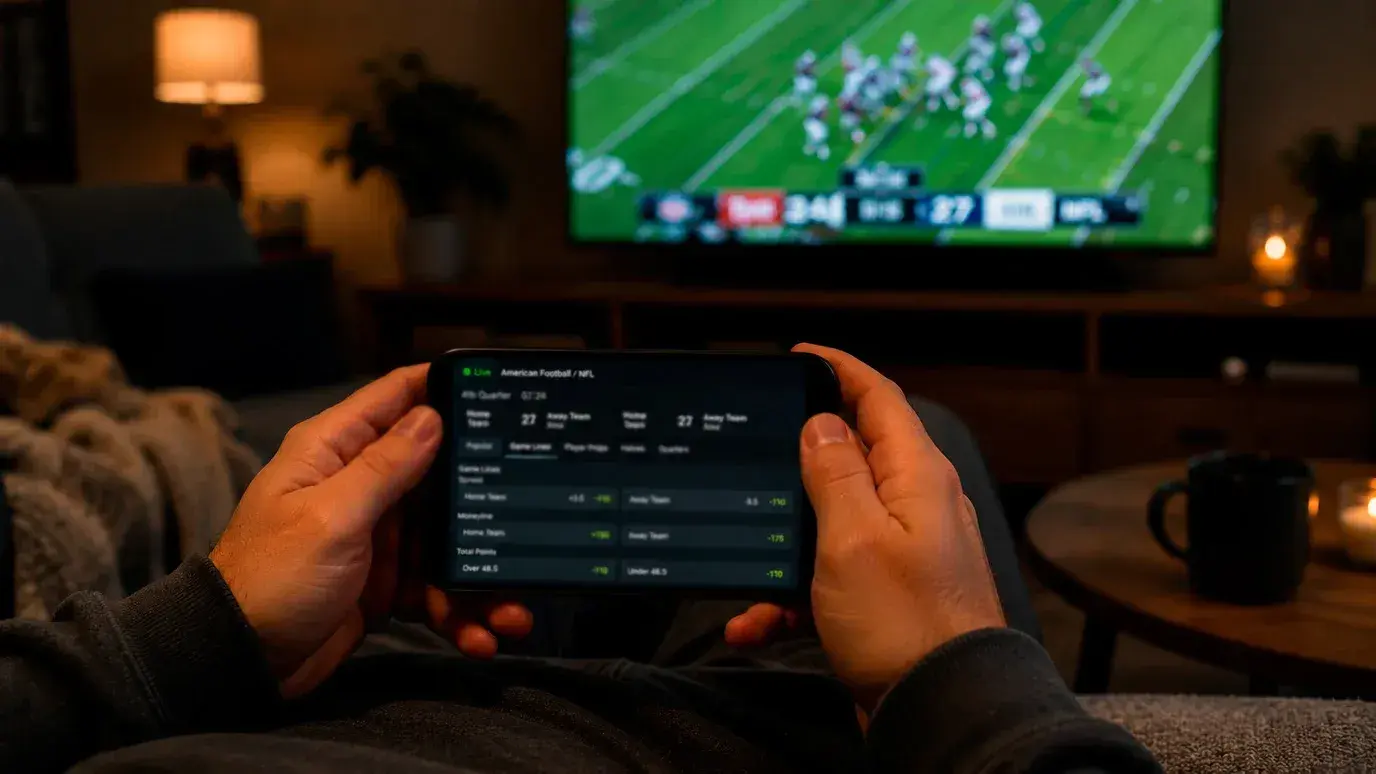
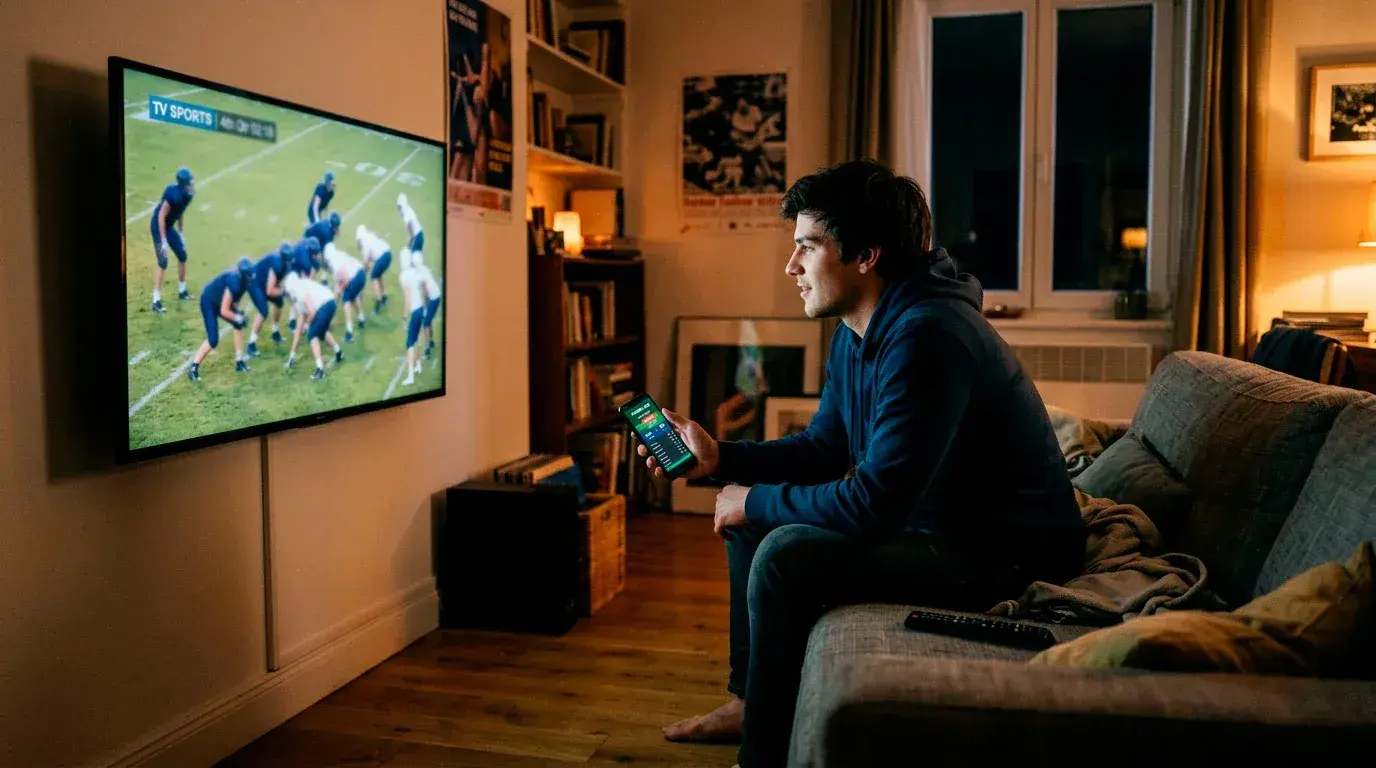
Ninety-five percent of UK online gambling happens from home, and 76% of bettors aged 18-24 use mobile phones as their primary device. For NFL viewing in the UK, this translates to a near-universal second-screen experience: television or laptop for the broadcast, phone for the betting app. The two screens are in constant dialogue during a game.
The second screen enables a style of engagement that did not exist a decade ago. You watch a team march down the field on television while simultaneously checking the in-play spread on your phone. You see a star receiver take a big hit and immediately check whether his yardage prop is still achievable. You notice the wind picking up on screen and glance at the live total to see if the market has adjusted. The app is not a distraction from the game—it is an augmentation layer.
This dual-screen behaviour also drives consumption of adjacent content. During commercial breaks (which NFL broadcasts have plenty of), UK fans check betting forums, scroll Twitter for injury updates, and compare odds across platforms. The betting app becomes the hub of a content ecosystem that keeps the fan engaged not just during plays but during the dead time between them.
The risk, of course, is that the second screen can overwhelm the first. I have caught myself so focused on in-play odds movements that I missed the actual play that caused them. The balance between watching the game as entertainment and monitoring the app as a betting tool is something every NFL bettor navigates, and there is no single right answer. My personal rule: I close the app during red-zone drives and watch the football. The bet will still be there when the drive ends.
NFL Fandom Growth in the UK: From Niche to 14.3 Million
The NFL’s UK fanbase has grown from a small community of enthusiasts watching Channel 4 highlights in the 1980s to 14.3 million people—nearly one in five Britons. Over 6 million viewers watched the 2025 London Games on television or online, setting a record for the international series. The growth trajectory shows no sign of flattening, with the 2026 schedule featuring three London games and the league’s continued investment in purpose-built facilities at Tottenham Hotspur Stadium.
Jamie Reynolds, a UK-based sports marketing consultant, observed that British fans are less tribal than American ones. They follow players and storylines rather than inheriting a franchise loyalty from family. This behavioural difference has implications for how betting interacts with fandom: UK fans are more willing to bet against “their” team when the data supports it, because the emotional attachment is to the sport and the experience rather than to a specific franchise’s success.
The growth in UK fandom and the growth in UK NFL betting are intertwined. London Games create spikes in both—fans who attend or watch a London Game are more likely to place their first NFL bet during that event than during a standard regular-season week. Once the first bet is placed, the pattern from the viewership data kicks in: they start watching more games, which creates more betting opportunities, which deepens their engagement, which makes them more likely to watch even more games. The flywheel is self-reinforcing.
UK NFL Betting Communities: Where Fans Connect
The UK NFL betting community is smaller than its Premier League equivalent but unusually engaged. Dedicated subreddits, Discord servers, and Twitter/X communities discuss spreads, player props, and weekly picks throughout the season. The quality of analysis varies wildly—some community members run sophisticated models; others post gut-feel accumulators—but the common thread is genuine enthusiasm for a sport that most participants discovered as adults rather than growing up with.
Forum culture in UK NFL betting tends to be more collaborative than competitive. Because the sport is niche enough that UK NFL bettors often feel like outsiders in the broader UK betting community, there is a shared identity that encourages information exchange rather than secrecy. Weekly threads discussing line value, injury reports, and weather conditions are common, and the discussion quality during playoff weeks rivals anything I have seen in US-focused communities.
Podcasts serve a similar function. Several UK-based NFL podcasts include betting segments, and while I take any tip from a podcast with appropriate scepticism, the contextual analysis—schedule spots, matchup breakdowns, situational factors—is often genuinely useful as an input into your own decision-making. The key is treating community analysis as one data point among many, not as a substitute for your own evaluation.