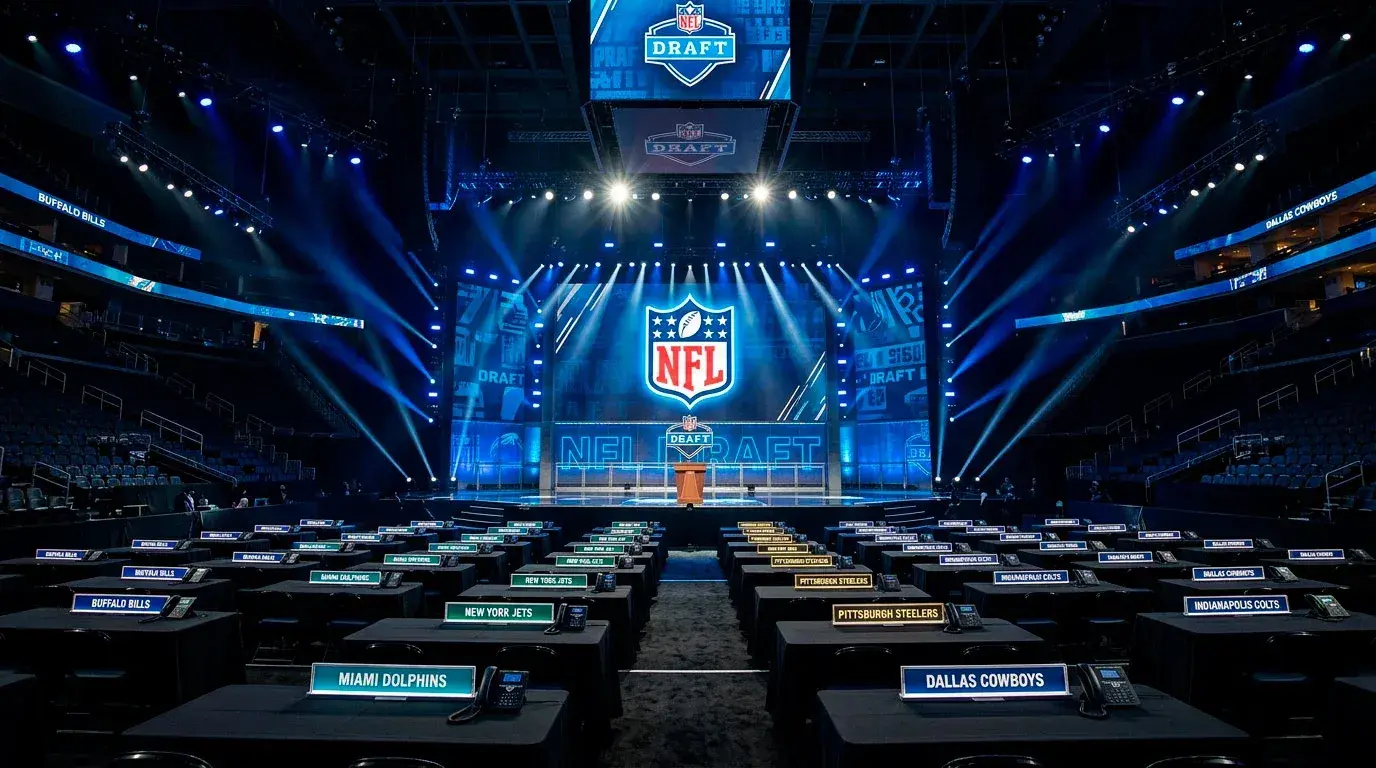
Every April, the NFL Draft turns into one of the strangest betting events on the UK calendar. There is no ball in play, no score to track, no defence to evaluate in real time. Instead, you are wagering on a series of decisions made by general managers behind closed doors, based on months of scouting, backroom trades, and medical reports that the public never sees. And yet, the Draft consistently produces some of the most tradeable betting markets of the NFL off-season, precisely because the information asymmetry creates volatile odds that move sharply on new data.
Each month, 1.2 million people in the UK search for NFL-related content—roughly 13% of the volume that the Premier League generates. A significant portion of that interest spikes during Draft week, when UK fans tune into coverage that starts at 1 AM and runs deep into the night. This guide covers the Draft betting markets available in the UK, what drives odds movement, and how to time your bets around the key information events.
Available Draft Betting Markets in the UK
The core Draft market is “first overall pick,” a straight outright bet on which player will be selected first. This market opens months in advance—sometimes before the college football season even ends—and the favourite can change several times between January and late April. Odds on the presumptive first pick typically range from 1/5 to 1/2, depending on how settled the consensus is.
Beyond the first pick, UK platforms offer a range of markets that vary in availability. “Top three picks” asks whether a named player will be selected within the first three selections. “First player drafted by position” covers the first quarterback, first wide receiver, first offensive lineman, and so on. “Over/under draft position” sets a line—say, 7.5—and you bet whether a named player will be drafted higher (under) or lower (over) than that number.
Some operators expand their Draft offering in the days immediately before the event, adding markets on specific team selections (“which position will the Bears draft first?”) and trade-related propositions (“will there be a trade in the top five picks?”). These niche markets carry wider margins because they are harder to price and attract less volume, but they can offer genuine value when you have a strong view based on beat reporting or team needs.
One limitation for UK punters: Draft betting availability is not universal across UKGC-licensed platforms. The larger operators with US-facing businesses tend to offer the deepest Draft markets because they can leverage the same pricing infrastructure. Smaller UK-only operators may list only the first overall pick, or skip Draft betting entirely.
What Moves NFL Draft Odds: Combine, Pro Days and Trades
Draft odds move on information, and the information arrives in a predictable sequence that creates distinct windows for betting. Understanding that sequence is the closest thing to a structural edge in this market.
The NFL Scouting Combine in late February or early March is the first major catalyst. Prospects run the 40-yard dash, complete agility drills, and undergo medical evaluations in front of every team’s scouting staff. A quarterback running a faster-than-expected 40 or a defensive end posting elite numbers in the vertical jump can shift his draft position by ten spots overnight. The market reacts within hours, sometimes overreacting to a single data point. Eighty-nine of the 100 most-watched TV programmes in the US during 2025 were NFL games, and the Draft’s growing media profile means Combine performances are amplified through social media and television coverage in ways that move odds further and faster than the underlying data warrants.
Pro Days—individual workouts hosted at each prospect’s university in March and early April—provide a second round of data. These events are more controlled than the Combine and often produce better numbers, which is why sharp bettors pay close attention to whether a prospect’s Pro Day performance changes the narrative or simply confirms existing expectations. A Pro Day that confirms consensus rarely moves the odds. One that contradicts it—a projected top-ten pick looking sluggish, or a Day 2 prospect testing like a first-rounder—can create significant price dislocations.
The final and most volatile catalyst is trade rumours in the 48 hours before the Draft. When reports surface that a team is moving up to select a specific player, odds collapse immediately. These moves are difficult to anticipate but easy to recognise—a player’s first-pick odds shortening from 8/1 to 2/1 in a single afternoon is almost always trade-driven.
When to Bet: Pre-Combine vs Draft Night
I place my Draft bets in two windows: the week before the Combine and the morning of the Draft itself. The reasoning is structural.
Pre-Combine, the market is pricing off college tape and early mock drafts. The odds are wide, the margins are large, and the public has not yet engaged in serious volume. If you have done your own evaluation—watching college film, tracking team needs, reading beat reporters who cover specific franchises—the pre-Combine window is where the biggest price edges exist. A prospect you believe is a top-five lock might be priced at 15/1 to go in the top three simply because the consensus has not caught up yet.
Draft morning is the second window. By this point, every piece of public information has been absorbed—Combine numbers, Pro Day results, trade rumours, interview leaks. The odds are tight, but specific markets may misprice based on the last 24 hours of rumour churn. I focus on team-specific markets at this stage, particularly “which position will Team X draft first,” because beat reporters often release credible intel about a franchise’s final board in the hours before the first pick.
The worst time to bet is during Draft night itself. Odds move with every pick, the platform’s latency may mean you are betting on stale prices, and the emotional intensity of watching the broadcast pushes you toward impulsive decisions. If your pre-Draft thesis has not been placed by the time the commissioner walks to the podium, let it go.
How UK Coverage of the Draft Affects Betting Activity
Jamie Reynolds, a UK-based sports marketing consultant, once noted that British fans tend to follow players and storylines rather than inheriting a team loyalty the way American fans do. That observation is particularly relevant to Draft betting, because UK punters are more likely to track high-profile prospects through the media cycle—following a quarterback’s Combine buzz or a receiver’s social media presence—than to have deep knowledge of which franchise needs what position.
UK television coverage of the Draft has expanded significantly. Multiple broadcasters now carry live coverage starting at 1 AM, with pre-draft analysis programmes airing in the early evening. This coverage drives betting volume on the most visible markets, particularly first overall pick and first quarterback selected, while leaving deeper markets—positional firsts, team-specific propositions—relatively untouched by casual money. If you want futures-style value in the Draft, the depth markets are where to look.
The time zone creates one additional dynamic: by the time the second and third rounds are picked on Day 2 and Day 3, UK viewership drops off sharply. Betting volume on later-round markets is thin, margins are wide, and price accuracy is lower. For the small number of UK punters willing to research Day 2 prospects and stay up late enough to bet them, these rounds can offer disproportionate value—though the stakes should reflect the uncertainty involved.